
Something I’ll just mention:
X(z) = φ^(1-φ) · √(F_n·P_n·2^n) · (1+z)^n_scale
Preceding “king” -
X(z) = φ^(13/20) · √(F_n·P_n·2^n) · (1+z)^n_scale
Compare to:
X(z) = φ^(φ-1) · √(F_n·P_n·2^n) · (1+z)^n_scale
The φ identity closest to φ^(13/20) ≈ 1.36723 is φ^(φ-1) = φ^(1/φ) ≈ 1.34636.
Or, tying back to D_{n,β}(r) style from much prior:
D_{n,β}(r) = φ^(φ-1) · √(φ · F_n · 2^(n+β) · P_n · Ω) · r^k
(with Ω ≈1 or symbolically 1 via the Euler/Ω C² bridge)**
The ~1.5% gap is easily eaten by a minor nudge to n_scale (e.g., 0.701 → ~0.715 for G(z)) — fits should stay excellent.
Now the alternate form again from much prior:
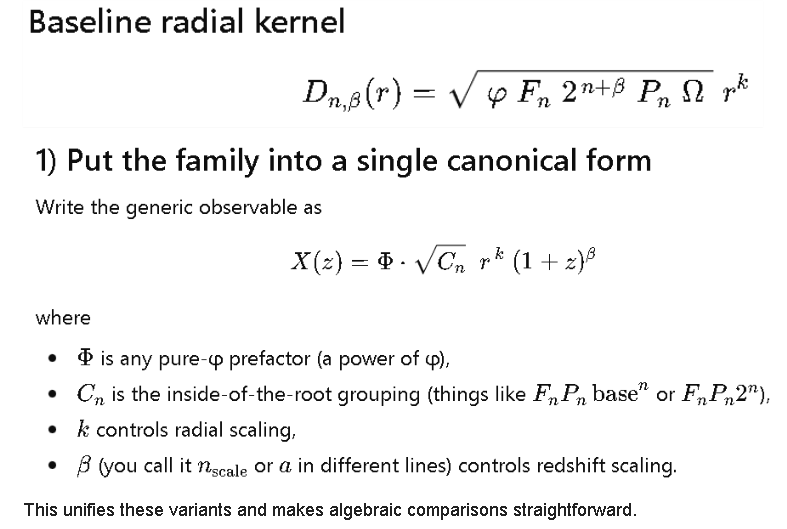
X(z) = φ · √(C_n) · r^k · (1+z)^B
Where:
- φ = any pure-phi prefactor (a power of φ, e.g. φ^1, φ^(φ-1), φ^(13/20), etc.)
- C_n = the inside-of-the-root grouping (F_n P_n base^n, or F_n P_n 2^n, or φ F_n P_n 2^n, etc.)
- k = radial scaling exponent
- B = redshift scaling (your n_scale or a)
(MUCH PRIOR)
Even tighter distillation options
- Ultimate minimal form:
X(z) = φ^(φ-1) · √(F_n · P_n · 2^n · Ω C²) · (1+z)^{n_scale}
With Ω C² = 1 symbolically (Euler bridge → √(-e^{iπ}) = 1). Scaling fully collapsed to mathematical unity.
Generalized skeleton (our alternate):
X(z) = φ · √(C_n) · r^k · (1+z)^B
Slot φ = φ^(φ-1), C_n = F_n P_n 2^n (or with φ inside). This is the most distilled meta-form — modular, flexible, and encompasses all variants.
** The Euler/Ω C² bridge (footnote)
Hz = 1/s
Combine Force and Ω, utilizing Hz, visa-vi units:
F = (ΩC²)/ms
Where C = coulomb, m = meters, s = seconds
or Ω = (Nms)/C²
Or C = (Nms) / CΩ (expressed in units)
Which is normally begotten as C = ((Nms)/Ω)^(1/2)

Fm = (ΩC²)/s where m = meters
Hz = (ΩC²)/s
Where ΩC² = 1
-ΩC² = -1
e^iπ = -ΩC² (Euler’s) or -e^iπ = ΩC²