
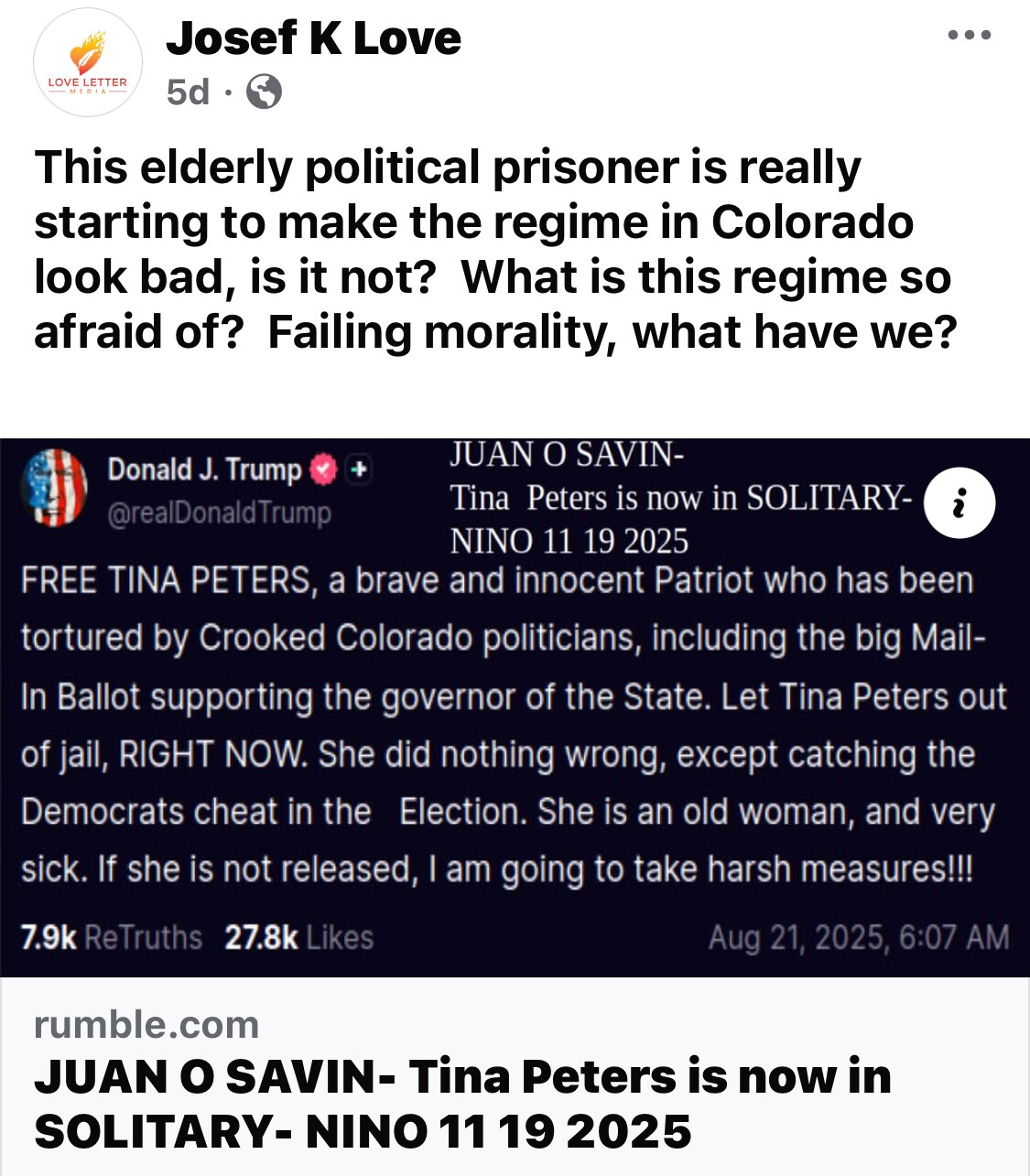
Ms. Tina Peters

The state of Colorado’s assertion that they have state rights over the so-called Federal jurisdiction or of the pardon is an interesting red herring. Let us ponder about this.

Tina Peters is a woman. The state asserts they have custody over her which is supreme to the Right of The People or our red herring.

No, Tina Peters is a woman.

Colorado asserting right supreme to Ms. Peters choosing the overt act of airlifting herself out of there is akin to slavery. This is covered by the writ of habeas corpus, the constructive portions of the 14th Amendment among other Rights. Let us think about that.


Source: Redirecting...

Colorado has commoditized Tina Peters. They have converted her to property of the state. In so doing, the state of Colorado asserts that state rights are supreme to this woman’s Right to choose Federal remedy. I scoff at the idea that Tina Peters would not choose remedy over sitting in a cold prison cell. Only if she seeks the full vindication which she appears to well deserve.

I kindly remind the purpose of government. The purpose of state and Federal government is to serve The People. This principle didn’t go away, could not have gone away.

Rather, the state of Colorado asserts its own rights over the Right of a woman under common Law. Does anyone else see the absurdity of this form of slavery and obstruction in the year 2025? Just what is the eighth amendment, among others, really for?


Lawfully.
Source: https://zchg.org/hott/

Ninth Amendment - The enumeration in the Constitution, of certain rights, shall not be construed to deny or disparage others retained by the people.

Tenth Amendment - The powers not delegated to the United States by the Constitution, nor prohibited by it to the States, are reserved to the States respectively, or to the people.

The Tenth Amendment was not written before the Ninth Amendment. The order of these Amendments was certainly intentional.

And then there is the issue of Federal jurisdiction in criminal prosecutions - why was Tina Peters tried at the state level and not the Federal level in the first place?

If the rigged vote was in fact in, is this rigging not a Federal issue? A Ninth Amendment issue?

This red herring points back to the issue we should really be discussing - why is Colorado able to assert control over a rigged election? Why is the fox being permitted to assert jurisdiction over the hen house in this narrow context? And what is treason if given the context?

As well, should the writ of habeas corpus ever descend to point of suspension, wouldn’t it be absurd that the president of the United States could not invoke that peacetime and also wartime Right at the behest of Ms. Peters? The suspension in times of war being applicable to those who revolt from our core principles, and not those certified by the Electoral College? The right of the individual being enumerated by the Ninth and again before the Tenth?

This and these, Right, retained by The People existed before they were enumerated.

Source: Redirecting...

Pray for Tina, yes, but pray also for all who are wrongly choosing to prey on her when her time comes for righteous indignation. Pray for mercy for they when the supreme Law of the land comes due.


Source: https://zchg.org/hott/late%20episodes/1410%20-%2029-Jun-98%20-%20Federal%20Jurisdiction%20%231.mp3

Lawfully.

image


Source: https://zchg.org/hott/late%20episodes/1412%20-%201-Jul-98%20-%20federal%20Jurisdiction%20%232%20–%20Wm%20Cooper.mp3

Lawfully.

Lets see what ChatGPT has to say. The opinions of ChatGPT are not necessarily those of Love Letter Media. Not responsible for error produced by bot, as usual.

I ran this gentleman’s post through our bot:

This Yielded:

Jailers, prison officials, and court clerks may not intentionally block or interfere with inmate filings to the court

The Supreme Court and the Seventh Circuit have long held that jailers, prison officials, and court clerks may not screen, block, or intentionally interfere with inmate legal filings in a manner that impedes access to the courts or causes actual injury to a legal claim. Such conduct violates the constitutional right of access to the courts and, in appropriate circumstances, the Due Process Clause.

The controlling authorities are grouped below by level and legal principle for direct use in briefing.


U.S. SUPREME COURT — CORE HOLDINGS

Ex parte Hull, 312 U.S. 546 (1941) — Foundational Case

Holding: Prison officials may not screen, censor, or refuse to forward an inmate’s habeas petition or other legal filings to a court.

“The state and its officers may not abridge or impair petitioner’s right to apply to a federal court for a writ of habeas corpus.”
Ex parte Hull, 312 U.S. at 549

This case establishes the core rule that jailers and prison officials may not interpose themselves between a prisoner and judicial review.


Bounds v. Smith, 430 U.S. 817 (1977)

Holding: Prisoners have a constitutional right of meaningful access to the courts, which includes the ability to prepare and submit legal documents.

“The right of access to the courts requires prison authorities to assist inmates in the preparation and filing of meaningful legal papers.”
Bounds, 430 U.S. at 828

Bounds recognizes the right of access; it does not dispense with the requirement of showing injury, which was later clarified in Lewis v. Casey.


Lewis v. Casey, 518 U.S. 343 (1996) — Clarifying Limitation

Holding: An access-to-courts violation occurs only where official interference actually hinders a nonfrivolous legal claim, such as by causing missed deadlines, dismissal, or inability to present claims.

Actual injury includes the loss or rejection of a claim due to obstruction or interference by officials.


Houston v. Lack, 487 U.S. 266 (1988) — Prison Mailbox Rule

Holding: A prisoner’s filing is deemed filed when delivered to prison officials for forwarding to the court.

“Prisoners cannot personally travel to the courthouse to see that the notice is stamped ‘filed’… they must entrust their notices of appeal to prison authorities.”
Houston, 487 U.S. at 271

Houston presupposes that prison officials will forward inmate filings and supports liability where intentional delay or obstruction causes prejudice.


SEVENTH CIRCUIT — DIRECTLY RELEVANT AUTHORITY

Antonelli v. Sheahan, 81 F.3d 1422 (7th Cir. 1996)

Holding: Jail officials violate the Constitution when they interfere with a prisoner’s outgoing legal mail, including correspondence to courts.

“Prison officials may not interfere with a prisoner’s legal mail.”
Antonelli, 81 F.3d at 1431


Lewis v. Sullivan, 279 F.3d 526 (7th Cir. 2002)

Holding: A failure to forward legal materials or correspondence that results in dismissal, delay, or prejudice to a legal action states a valid access-to-courts claim, provided actual injury is shown.


Zimmerman v. Tribble, 226 F.3d 568 (7th Cir. 2000)

Holding: Prison officials may be liable where their actions impede access to legal materials or processes and cause prejudice to pending or contemplated litigation.


Guajardo-Palma v. Martinson, 622 F.3d 801 (7th Cir. 2010)

Holding: Interference with legal correspondence that hinders an inmate’s access to the courts violates the First Amendment and the constitutional right of access to the courts when it causes actual injury.


Snyder v. Nolen, 380 F.3d 279 (7th Cir. 2004) — Court Clerks

Holding: Court clerks and officials acting in a ministerial capacity violate due process when they arbitrarily or intentionally refuse to file or process pleadings properly submitted to the court.


CORE LEGAL RULE (BLACK-LETTER)

Jailers, prison officials, and court clerks may not intentionally screen, block, or refuse to forward inmate legal filings in a manner that interferes with access to the courts. Such conduct violates the First Amendment and the Due Process Clause when it causes actual injury to a nonfrivolous legal claim.
Ex parte Hull v. Michigan, 312 U.S. 546 (1941); Lewis v. Casey, 518 U.S. 343 (1996); Antonelli v. Sheahan, 81 F.3d 1422 (7th Cir. 1996); Snyder v. Nolen, 380 F.3d 279 (7th Cir. 2004).


RULE STATEMENT (DROP-IN READY)

Prison officials violate clearly established constitutional law when they intentionally interfere with inmate pleadings or legal mail in a manner that impedes access to the courts and causes actual injury. The Supreme Court has long held that jailers may not interpose themselves between a prisoner and judicial review. Ex parte Hull v. Michigan, 312 U.S. 546 (1941); Houston v. Lack, 487 U.S. 266 (1988). The Seventh Circuit has repeatedly enforced this principle. Antonelli v. Sheahan, 81 F.3d 1422 (7th Cir. 1996).


QUALIFIED IMMUNITY — CLEARLY ESTABLISHED LAW

Because the prohibition on screening or obstructing inmate access to courts has been established since Ex parte Hull (1941):

:check_mark: A reasonable jailer or clerk is on notice that intentional interference with court filings is unlawful

:check_mark: Qualified immunity is unavailable where intentional conduct and actual injury are shown
:check_mark: Personal liability may attach under § 1983 for deliberate obstruction or refusal to forward filings

image