https://www.youtube.com/results?search_query=the+prison+industrial+complex
More later on.
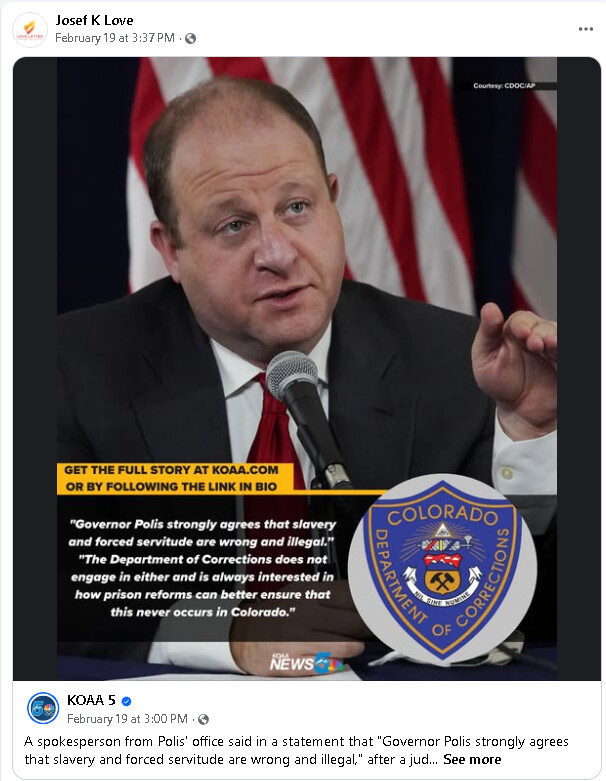
https://www.facebook.com/share/p/17scmed2mE/
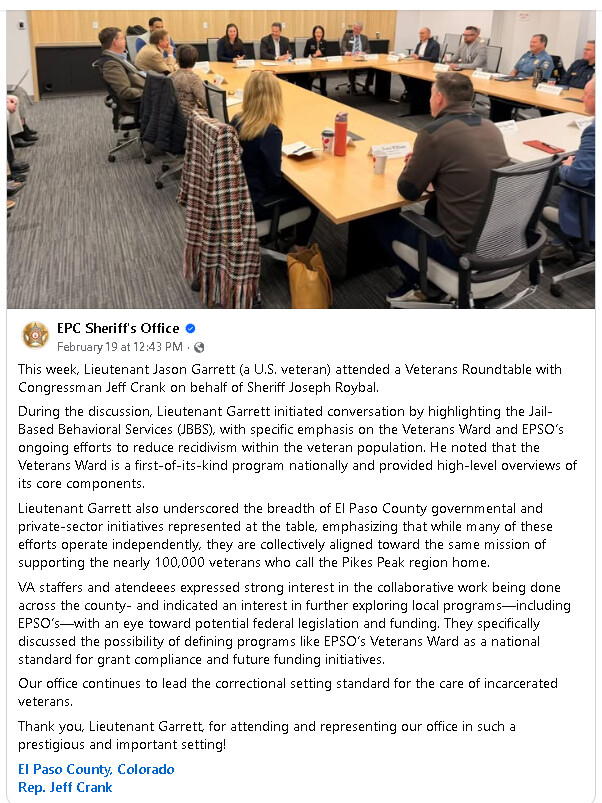

https://www.youtube.com/results?search_query=the+prison+industrial+complex
More later on.
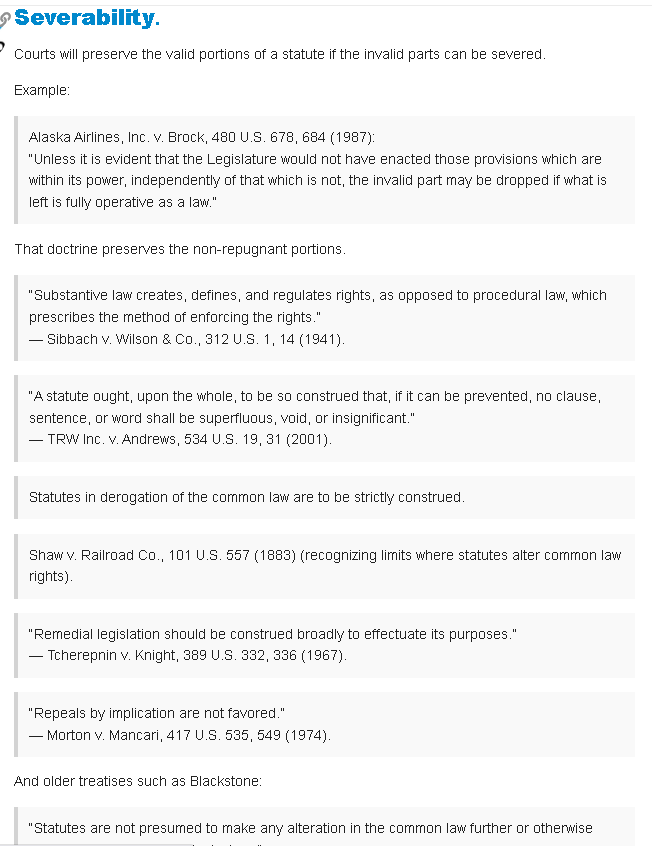
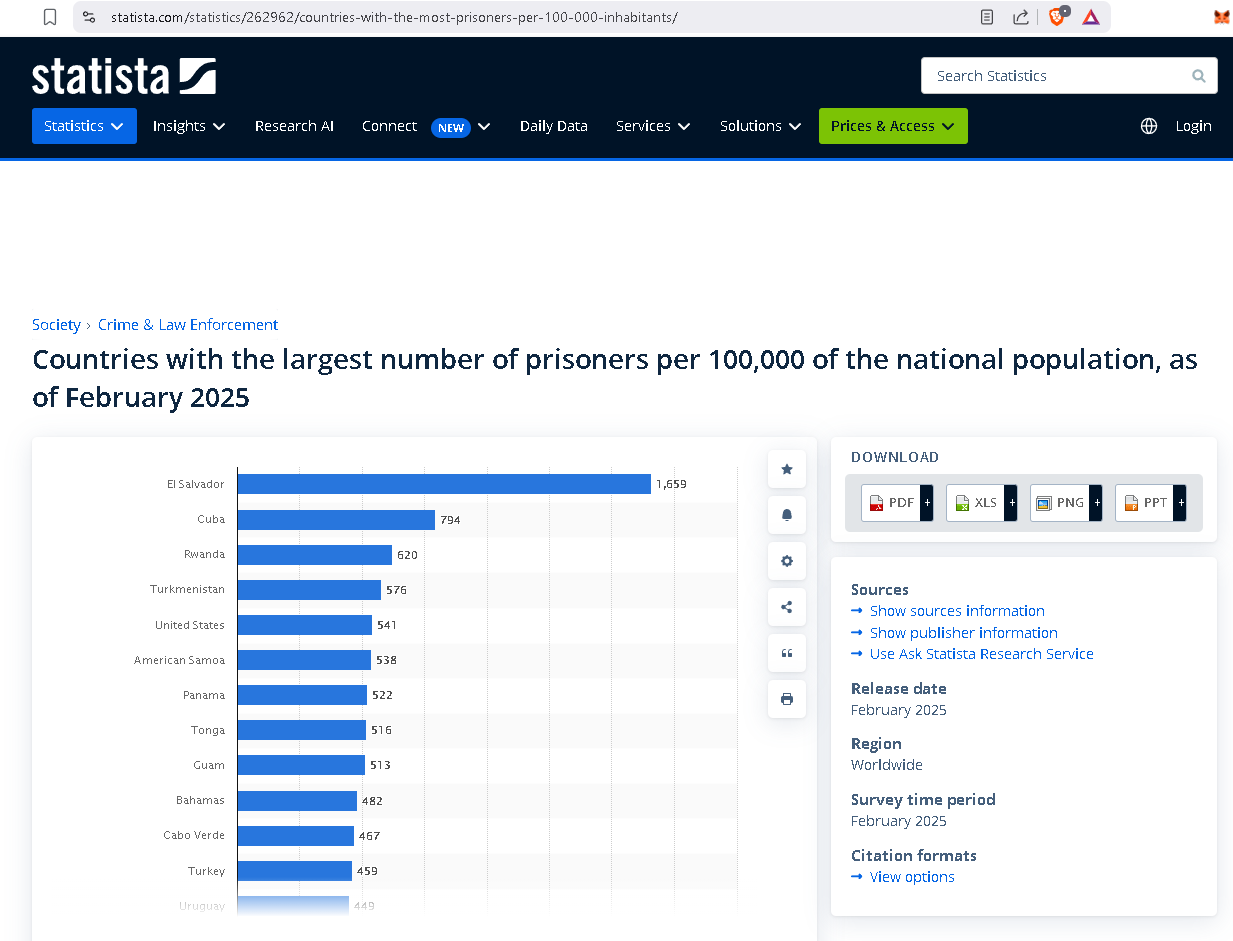
And I’m told the US used to be EVEN WORSE on this list, not so long ago..

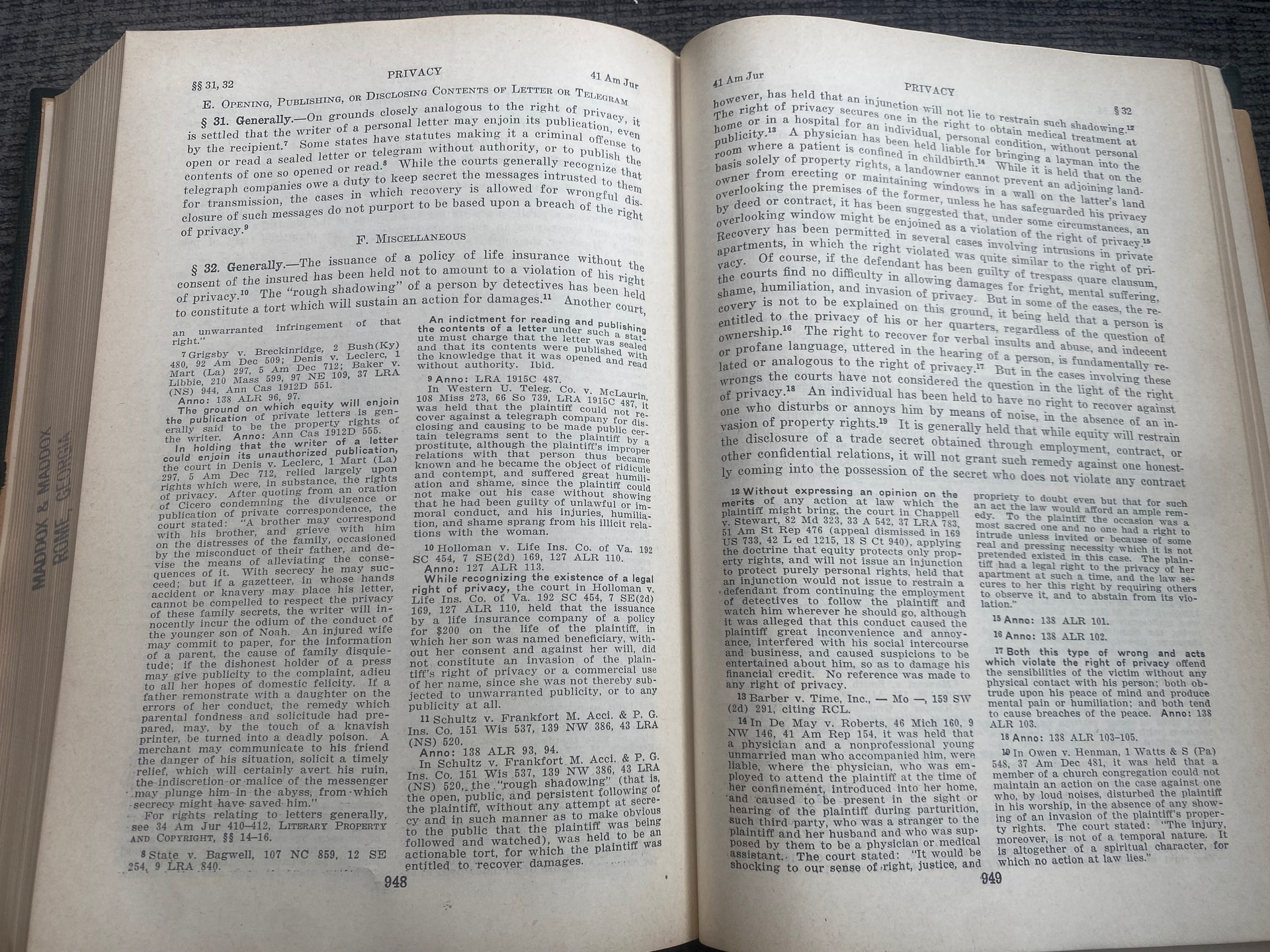
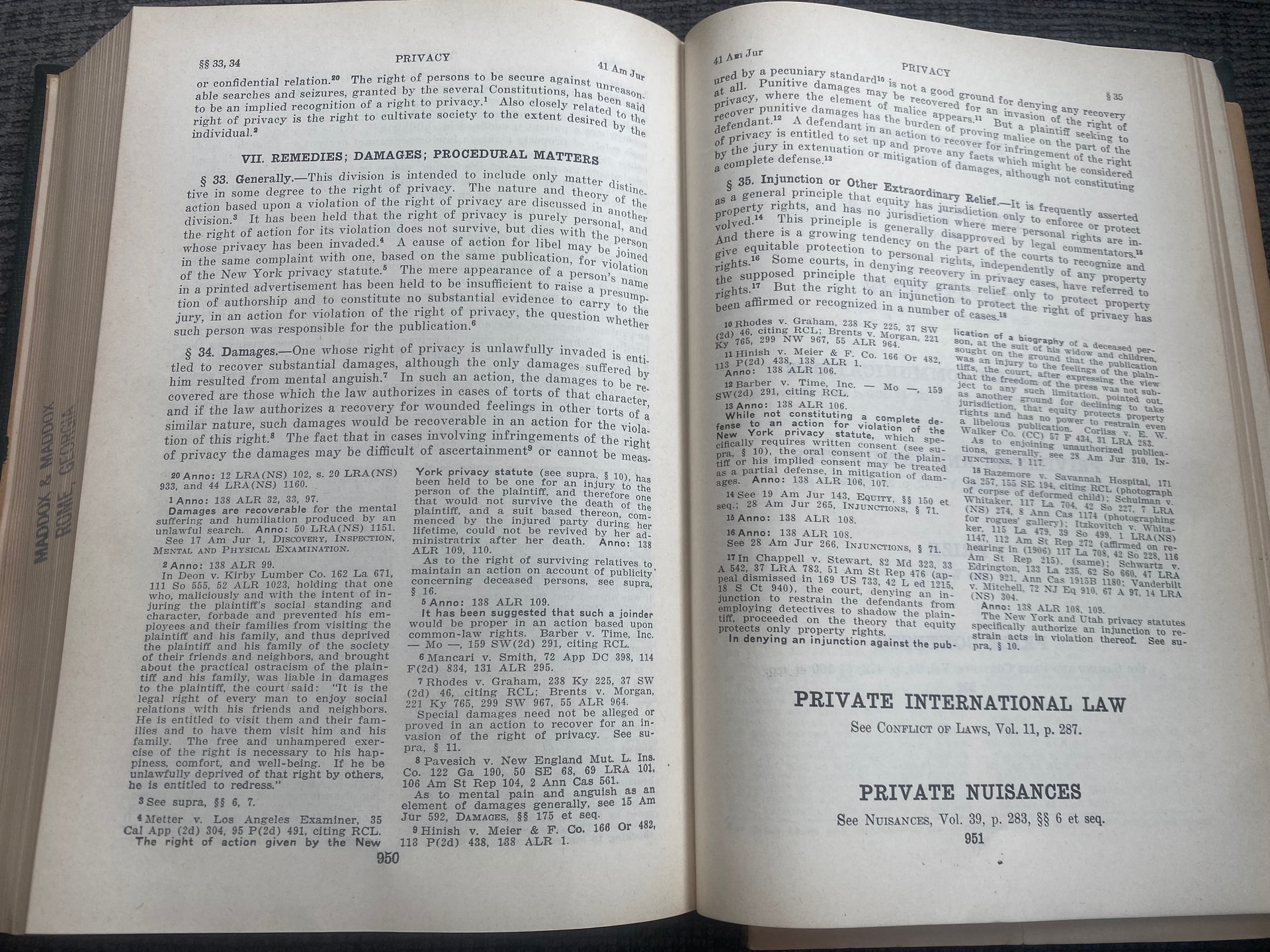
## American Jurisprudence, First Edition

### Pages 924–951

---

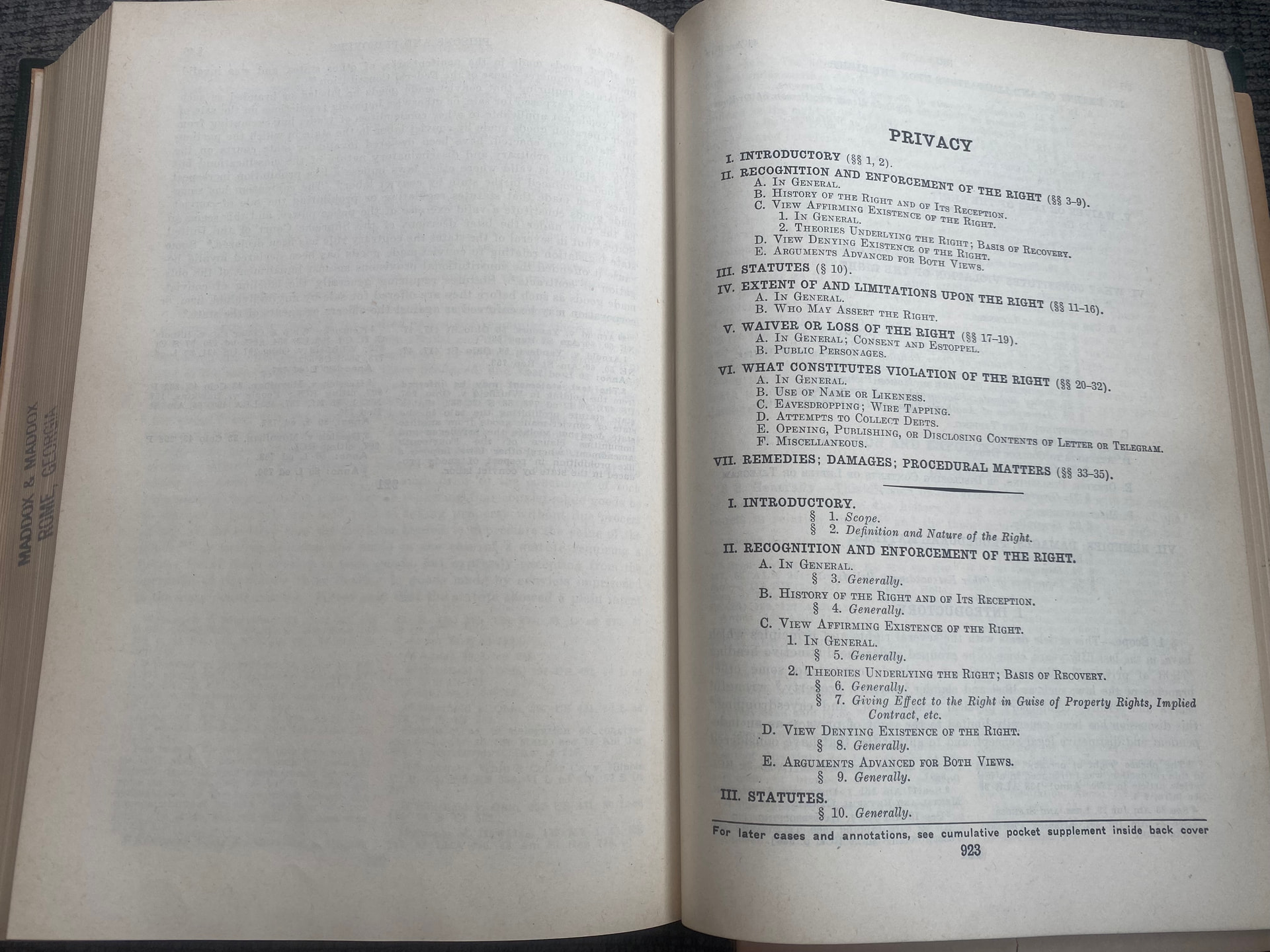
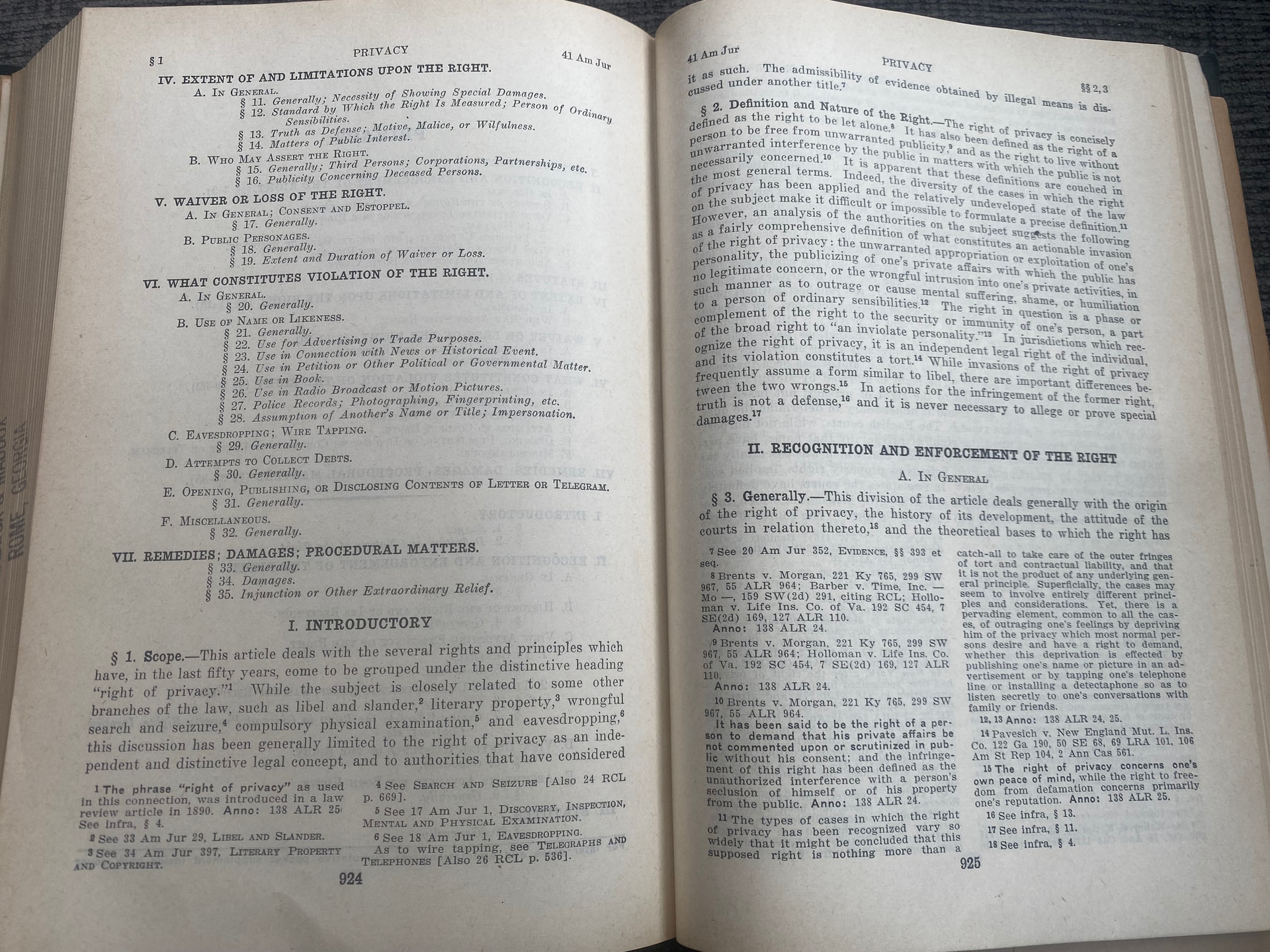
## TABLE OF CONTENTS (from p. 924)

**I. INTRODUCTORY**

* § 1. Scope.

**II. RECOGNITION AND ENFORCEMENT OF THE RIGHT**

A. In General.

* § 3. Generally.

B. History of the Right and of Its Reception.

* § 4. Generally.

C. View Affirming Existence of the Right.

1. In General.

* § 5. Generally.

2. Theories Underlying the Right; Basis of Recovery.

* § 6. Generally.

D. View Denying Existence of the Right.

* § 8. Generally.

E. Arguments Advanced for Both Views.

* § 9. Generally.

**III. STATUTES**

* § 10. Generally.

**IV. EXTENT OF AND LIMITATIONS UPON THE RIGHT**

A. In General.

* § 11. Generally; Necessity of Showing Special Damages.
* § 12. Standard by Which the Right Is Measured; Person of Ordinary Sensibilities.
* § 13. Truth as Defense; Motive, Malice, or Wilfulness.
* § 14. Matters of Public Interest.

B. Who May Assert the Right.

* § 15. Generally; Third Persons; Corporations, Partnerships, etc.
* § 16. Publicity Concerning Deceased Persons.

**V. WAIVER OR LOSS OF THE RIGHT**

A. In General; Consent and Estoppel.

* § 17. Generally.
* § 19. Extent and Duration of Waiver or Loss.

B. Public Personages.

* § 18. Generally.

**VI. WHAT CONSTITUTES VIOLATION OF THE RIGHT**

A. In General.

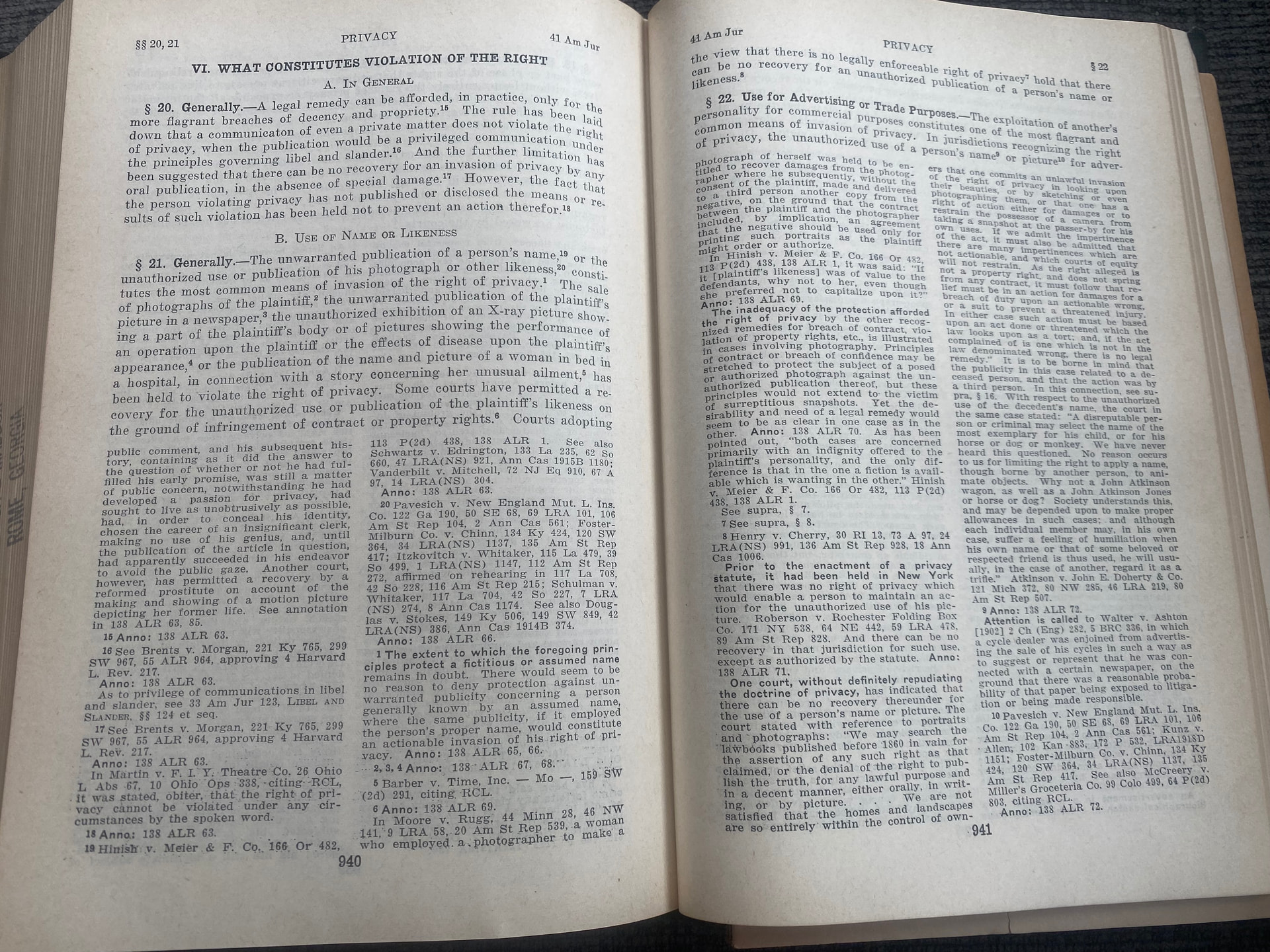
* § 20. Generally.

B. Use of Name or Likeness.

* § 21. Generally.
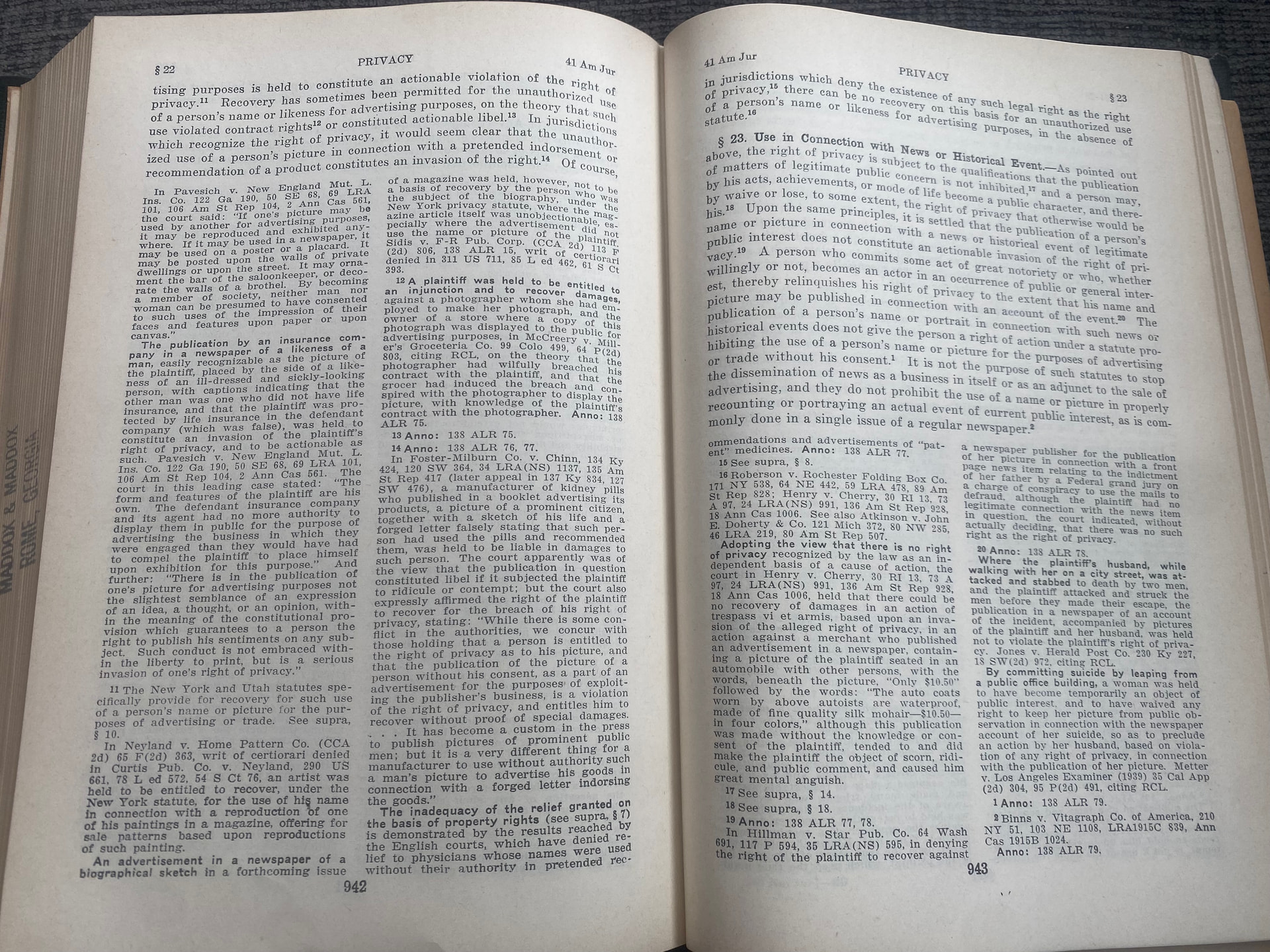
* § 22. Use for Advertising or Trade Purposes.
* § 23. Use in Connection with News or Historical Event.
* § 24. Use in Petition or Other Political or Governmental Matter.
* § 25. Use in Book.
* § 26. Use in Radio Broadcast or Motion Pictures.
* § 27. Police Records; Photographing, Fingerprinting, etc.
* § 28. Assumption of Another's Name or Title; Impersonation.

C. Eavesdropping; Wire Tapping.

* § 29. Generally.

D. Attempts to Collect Debts.

* § 30. Generally.

E. Opening, Publishing, or Disclosing Contents of Letter or Telegram.

* § 31. Generally.

F. Miscellaneous.

* § 32. Generally.

**VII. REMEDIES; DAMAGES; PROCEDURAL MATTERS**

* § 33. Generally.
* § 34. Damages.
* § 35. Injunction or Other Extraordinary Relief.

---

## I. INTRODUCTORY

**§ 1. Scope.** — This article deals with the several rights and principles which have, in the last fifty years, come to be grouped under the distinctive heading "right of privacy."¹ While the subject is closely related to some other branches of the law, such as libel and slander,² literary property,³ wrongful search and seizure,⁴ compulsory physical examination,⁵ and eavesdropping,⁶ this discussion has been generally limited to the right of privacy as an independent and distinctive legal concept, and to authorities that have considered it as such. The admissibility of evidence obtained by illegal means is discussed under another title.⁷

¹ The phrase "right of privacy" as used in this connection, was introduced in a law review article in 1890. Anno: 138 ALR 25. See Infra, § 4. ² See 33 Am Jur 29, LIBEL AND SLANDER. ³ See 34 Am Jur 397, LITERARY PROPERTY AND COPYRIGHT. ⁴ See SEARCH AND SEIZURE [Also 24 RCL p. 669]. ⁵ See 17 Am Jur 1, DISCOVERY, INSPECTION, MENTAL AND PHYSICAL EXAMINATION. ⁶ See 18 Am Jur 1, EAVESDROPPING. As to wire tapping, see TELEGRAPHS AND TELEPHONES [Also 26 RCL p. 536]. ⁷ See 20 Am Jur 352, EVIDENCE, §§ 393 et seq.

---

## II. RECOGNITION AND ENFORCEMENT OF THE RIGHT

### A. In General

**§ 2. Definition and Nature of the Right.** — The right of privacy is concisely defined as the right to be let alone.⁸ It has also been defined as the right of a person to be free from unwarranted publicity,⁹ and as the right to live without unwarranted interference by the public in matters with which the public is not necessarily concerned.¹⁰ It is apparent that these definitions are couched in the most general terms. Indeed, the diversity of the cases in which the right of privacy has been applied and the relatively undeveloped state of the law on the subject make it difficult or impossible to formulate a precise definition.¹¹ However, an analysis of the authorities on the subject suggests the following as a fairly comprehensive definition of what constitutes an actionable invasion of the right of privacy: the unwarranted appropriation or exploitation of one's personality, the publicizing of one's private affairs with which the public has no legitimate concern, or the wrongful intrusion into one's private activities, in such manner as to outrage or cause mental suffering, shame, or humiliation to a person of ordinary sensibilities.¹² The right in question is a phase or complement of the right to the security or immunity of one's person, a part of the broad right to "an inviolate personality."¹³ In jurisdictions which recognize the right of privacy, it is an independent legal right of the individual, and its violation constitutes a tort.¹⁴ While invasions of the right of privacy frequently assume a form similar to libel, there are important differences between the two wrongs.¹⁵ In actions for the infringement of the former right, truth is not a defense,¹⁶ and it is never necessary to allege or prove special damages.¹⁷

⁸ Brents v. Morgan, 221 Ky 765, 299 SW 967, 55 ALR 964; Barber v. Time, Inc. — Mo —, 159 SW(2d) 291, citing RCL; Holloman v. Life Ins. Co. of Va. 192 SC 454, 7 SE(2d) 169, 127 ALR 110. Anno: 138 ALR 24. ⁹ Brents v. Morgan, 221 Ky 765, 299 SW 967, 55 ALR 964; Holloman v. Life Ins. Co. of Va. 192 SC 454, 7 SE(2d) 169, 127 ALR 110. Anno: 138 ALR 24. ¹⁰ It has been said to be the right of a person to demand that his private affairs be not commented upon or scrutinized in public without his consent; and the infringement of this right has been defined as the unauthorized interference with a person's seclusion of himself or of his property from the public. Anno: 138 ALR 24. ¹¹ Anno: 138 ALR 24. ¹² Brents v. Morgan, 221 Ky 765, 299 SW 967, 55 ALR 964; Barber v. Time, Inc. — Mo —, 159 SW(2d) 291, citing RCL; Holloman v. Life Ins. Co. of Va. 192 SC 454, 7 SE(2d) 169, 127 ALR 110. Anno: 138 ALR 24. ¹³ Anno: 138 ALR 24. ¹⁴ Pavesich v. New England Mut. L. Ins. Co. 122 Ga 190, 50 SE 68, 69 LRA 101, 106 Am St Rep 104, 2 Ann Cas 561. ¹⁵ The right of privacy concerns one's own peace of mind, while the right to freedom from defamation concerns primarily one's reputation. Anno: 138 ALR 25. ¹⁶ See infra, § 13. ¹⁷ See infra, § 11. ¹⁸ See infra, § 4.

**§ 3. Generally.** — This division of the article deals generally with the origin of the right of privacy, the history of its development, the attitude of the courts in relation thereto,¹⁸ and the theoretical bases to which the right has been ascribed;¹⁹ it also points out which jurisdictions have affirmed and which have denied the existence of such a right,²⁰ and discusses the various arguments that have been advanced on both sides of the question.¹

¹⁹ See infra, §§ 6, 7. ²⁰ See infra, §§ 4, 5, 8. ¹ See infra, § 9.

### B. History of the Right and of Its Reception

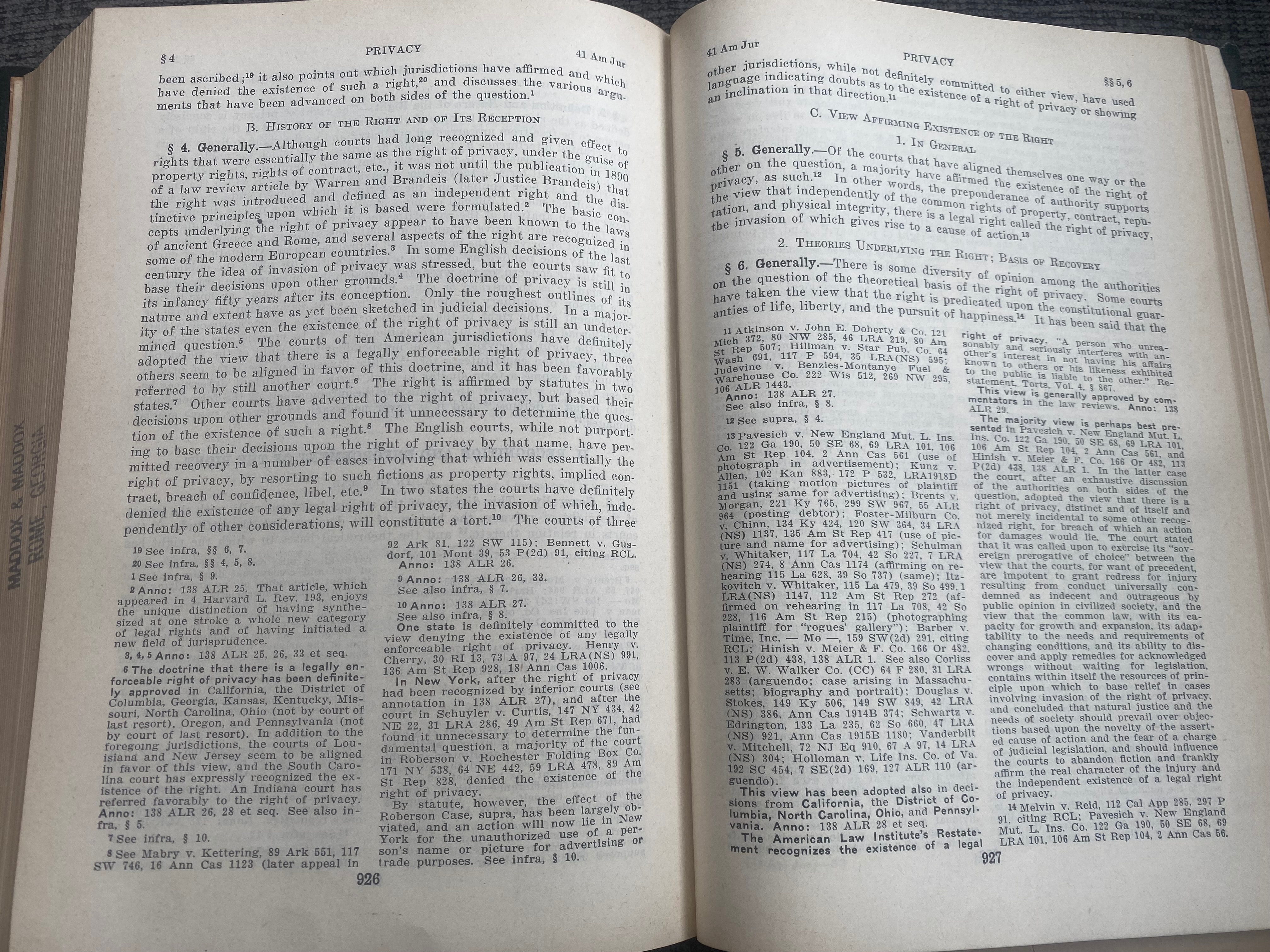
**§ 4. Generally.** — Although courts had long recognized and given effect to rights that were essentially the same as the right of privacy, under the guise of property rights, rights of contract, etc., it was not until the publication in 1890 of a law review article by Warren and Brandeis (later Justice Brandeis) that the right was introduced and defined as an independent right and the distinctive principles upon which it is based were formulated.² The basic concepts underlying the right of privacy appear to have been known to the laws of ancient Greece and Rome, and several aspects of the right are recognized in some of the modern European countries.³ In some English decisions of the last century the idea of invasion of privacy was stressed, but the courts saw fit to base their decisions upon other grounds.⁴ The doctrine of privacy is still in its infancy fifty years after its conception. Only the roughest outlines of its nature and extent have as yet been sketched in judicial decisions. In a majority of the states even the existence of the right of privacy is still an undetermined question.⁵ The courts of ten American jurisdictions have definitely adopted the view that there is a legally enforceable right of privacy, three others seem to be aligned in favor of this doctrine, and it has been favorably referred to by still another court.⁶ The right is affirmed by statutes in two states.⁷ Other courts have adverted to the right of privacy, but based their decisions upon other grounds and found it unnecessary to determine the question of the existence of such a right.⁸ The English courts, while not purporting to base their decisions upon the right of privacy by that name, have permitted a recovery in a number of cases involving that which was essentially the right of privacy, by resorting to such fictions as property rights, implied contract, breach of confidence, libel, etc.⁹ In two states the courts have definitely denied the existence of any legal right of privacy, the invasion of which, independently of other considerations, will constitute a tort.¹⁰ The courts of three

² Anno: 138 ALR 25, 26, 33. See also infra, § 7. ³ Anno: 138 ALR 26. ⁴ Anno: 138 ALR 26, 33. See also infra, § 7. ⁵ Anno: 138 ALR 27. See also infra, § 8. ⁶ The doctrine that there is a legally enforceable right of privacy has been definitely approved in California, the District of Columbia, Georgia, Kansas, Kentucky, Missouri, North Carolina, Ohio (not by court of last resort), Oregon, and Pennsylvania (not by court of last resort). In addition to the foregoing jurisdictions, the courts of Louisiana and New Jersey seem to be aligned in favor of this view, and the South Carolina court has expressly recognized the existence of the right. An Indiana court has referred favorably to the right of privacy. Anno: 138 ALR 26, 28 et seq. See also infra, § 5. ⁷ See infra, § 5. ⁸ See Mabry v. Kettering, 89 Ark 551, 117 SW 746, 16 Ann Cas 1123 (later appeal in ⁹ Anno: 138 ALR 27. ¹⁰ Anno: 138 ALR 27.

other jurisdictions, while not definitely committed to either view, have used language indicating doubts as to the existence of a right of privacy or showing an inclination in that direction.¹¹

¹¹ Anno: 138 ALR 27.

### C. View Affirming Existence of the Right

**1. In General**

**§ 5. Generally.** — Of the courts that have aligned themselves one way or other on the question, a majority have affirmed the existence of the right of privacy, as such.¹² In other words, the preponderance of authority supports the view that independently of the common rights of property, contract, reputation, and physical integrity, there is a legal right called the right of privacy, the invasion of which gives rise to a cause of action.

¹² Atkinson v. John E. Doherty & Co. 121 Mich 372, 80 NW 285, 46 LRA 219, 80 Am St Rep 507; Hillman v. Star Pub. Co. 64 Wash 691, 117 P 594, 35 LRA(NS) 595; Judevine v. Benzies-Montanye Fuel & Warehouse Co. 222 Wis 512, 269 NW 295, 106 ALR 1443. Anno: 138 ALR 27. See also infra, § 4.

**2. Theories Underlying the Right; Basis of Recovery**

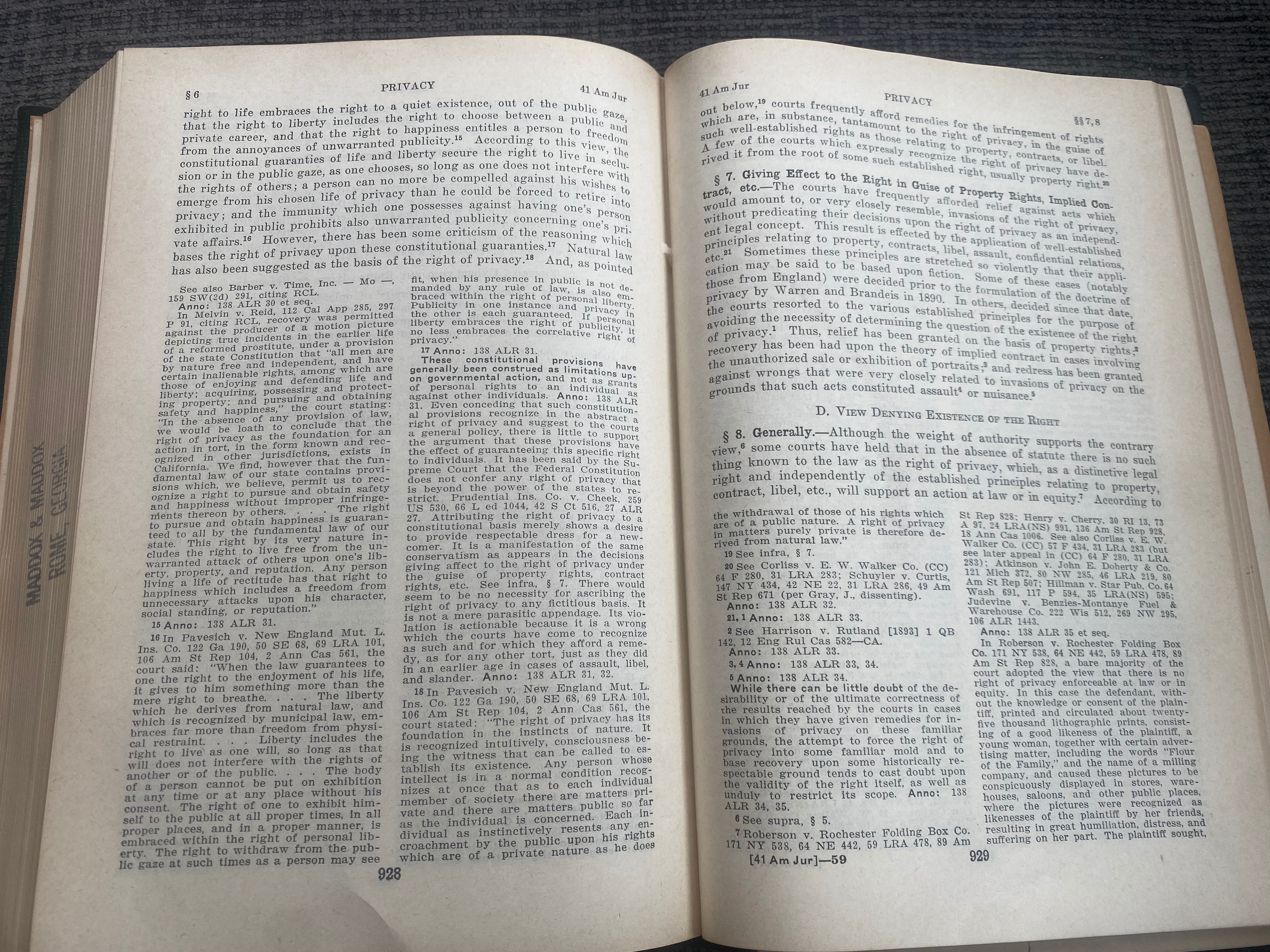
**§ 6. Generally.** — There is some diversity of opinion among the authorities on the question of the theoretical basis of the right of privacy. Some courts have taken the view that the right is predicated upon the constitutional guaranties of life, liberty, and the pursuit of happiness.¹⁴ It has been said that the right to life embraces the right to a quiet existence, out of the public gaze, that the right to liberty includes the right to choose between a public and private career, and that the right to happiness entitles a person to freedom from the annoyances of unwarranted publicity.¹⁵ According to this view, the constitutional guaranties of life and liberty secure the right to live in seclusion or in the public gaze, as one chooses, so long as one does not interfere with the rights of others; a person can no more be compelled against his wishes to emerge from his chosen life of privacy; and the immunity which one possesses against having one's person exhibited in public prohibits also unwarranted publicity concerning one's private affairs.¹⁶ However, there has been some criticism of the reasoning which bases the right of privacy upon these constitutional guaranties.¹⁷ Natural law has also been suggested as the basis of the right of privacy.¹⁸ And, as pointed out below,¹⁹ courts frequently afford remedies for the infringement of rights which are, in substance, tantamount to the right of privacy, in the guise of such well-established rights as those relating to property, contracts, or libel. A few of the courts which expressly recognize the right of privacy have derived it from the root of some such established right, usually property right.²⁰

¹⁴ Anno: 138 ALR 31. ¹⁵ Anno: 138 ALR 31. ¹⁶ Anno: 138 ALR 31. These constitutional provisions have generally been construed as limitations upon governmental action, and not as grants of constitutional rights to the individual as against other individuals. Anno: 138 ALR 31. Even conceding that such constitutional provisions recognize in the abstract a right of privacy and suggest to the courts the argument that these provisions have the effect of guaranteeing this specific right to individuals, it has been said by the Supreme Court that the Federal Constitution does not confer any right of privacy that would restrict the powers of the state. Prudential Ins. Co. v. Cheek, 259 US 530, 66 L ed 1044, 42 S Ct 516, 27 ALR 27. The right established on this constitutional basis merely shows ability to provide respectable dress for a newcomer. It is also a manifestation of the same conservatism as appears in the decisions giving effect to the right of privacy under the guise of property rights, contract and tort. There would seem to be no necessity for ascribing the right of privacy to any fictitious basis. It is not a mere parasitic appendage. It is not actionable because it is a wrong which the courts have come to recognize as such and for which they afford a remedy, as for any other tort, just as they did in an earlier age in cases of assault, libel, and slander. Anno: 138 ALR 31, 32. ¹⁷ Anno: 138 ALR 31. ¹⁸ In Pavesich v. New England Mut. L. Ins. Co. 122 Ga 190, 50 SE 68, 69 LRA 101, 106 Am St Rep 104, 2 Ann Cas 561, the court stated: "The right of privacy has its foundation in the instincts of nature. It is recognized intuitively, consciousness being the witness that can be called to establish its existence. Any person whose intellect is in a normal condition recognizes at once that as to each individual member of society there are matters private and there are matters public so far as the individual as concerned. Each individual as instinctively resents any encroachment by the public upon his rights which are of a private nature as he does ¹⁹ See infra, § 7. ²⁰ Anno: 138 ALR 33.

**§ 7. Giving Effect to the Right in Guise of Property Rights, Implied Contract, etc.** — The courts have frequently afforded relief against acts which would amount to, or very closely resemble, invasions of the right of privacy, without predicating their decisions upon the right of privacy as an independent legal concept. This result is effected by the application of well-established principles relating to property, contracts, libel, assault, confidential relations, etc.²¹ Sometimes these principles are stretched so violently that their application may be said to be based upon fiction. Some of these cases (notably those from England) were decided prior to the formulation of the doctrine of privacy by Warren and Brandeis in 1890. In others, decided since that date, avoiding the necessity of determining the question of the existence of the right of privacy.¹ Thus, relief has been granted on the basis of property rights,² the theory of implied contract in cases involving the unauthorized sale or exhibition of portraits,³ and redress has been granted against wrongs that were very closely related to invasions of privacy on the grounds that such acts constituted assault⁴ or nuisance.⁵

²¹ Anno: 138 ALR 33. ¹ Anno: 138 ALR 33, 34. ² Anno: 138 ALR 33. ³ Anno: 138 ALR 33. ⁴ Anno: 138 ALR 33, 34. ⁵ Anno: 138 ALR 33.

### D. View Denying Existence of the Right

**§ 8. Generally.** — Although the weight of authority supports the contrary view,⁶ some courts have held that in the absence of statute there is no such thing known to the law as the right of privacy, which, as a distinctive legal right and independently of the established principles relating to property, contract, libel, etc., will support an action at law or in equity.⁷ According to this view, invasion of privacy and unwarranted notoriety are beyond the domain of positive law, and a person is protected against such wrongs only by a voluntary observance by others of the code of common decency.⁸ A few courts, without definitely committing themselves to the view that there is no such thing as a legal right of privacy, have indulged in language indicating a predisposition to such a view.⁹

⁶ See supra, § 5. ⁷ Roberson v. Rochester Folding Box Co. 171 NY 538, 64 NE 442, 59 LRA 478, 89 Am St Rep 828; Henry v. Cherry, 30 RI 13, 73 A 97, 24 LRA(NS) 991, 136 Am St Rep 928, 18 Ann Cas 1006. See also Corliss v. E. W. Walker Co. (CC) 64 F 280, 31 LRA 283; Schuyler v. Curtis, 147 NY 434, 42 NE 22, 31 LRA 286, 49 Am St Rep 671 (per Gray, J., dissenting). Anno: 138 ALR 32. ⁸ In Pavesich v. New England Mut. L. Ins. Co. 122 Ga 190, 50 SE 68, 69 LRA 101, 106 Am St Rep 104, 2 Ann Cas 561, the court, after stating that this was an earlier age in cases of assault, libel, and slander. Anno: 138 ALR 31, 32. ⁹ Anno: 138 ALR 38.

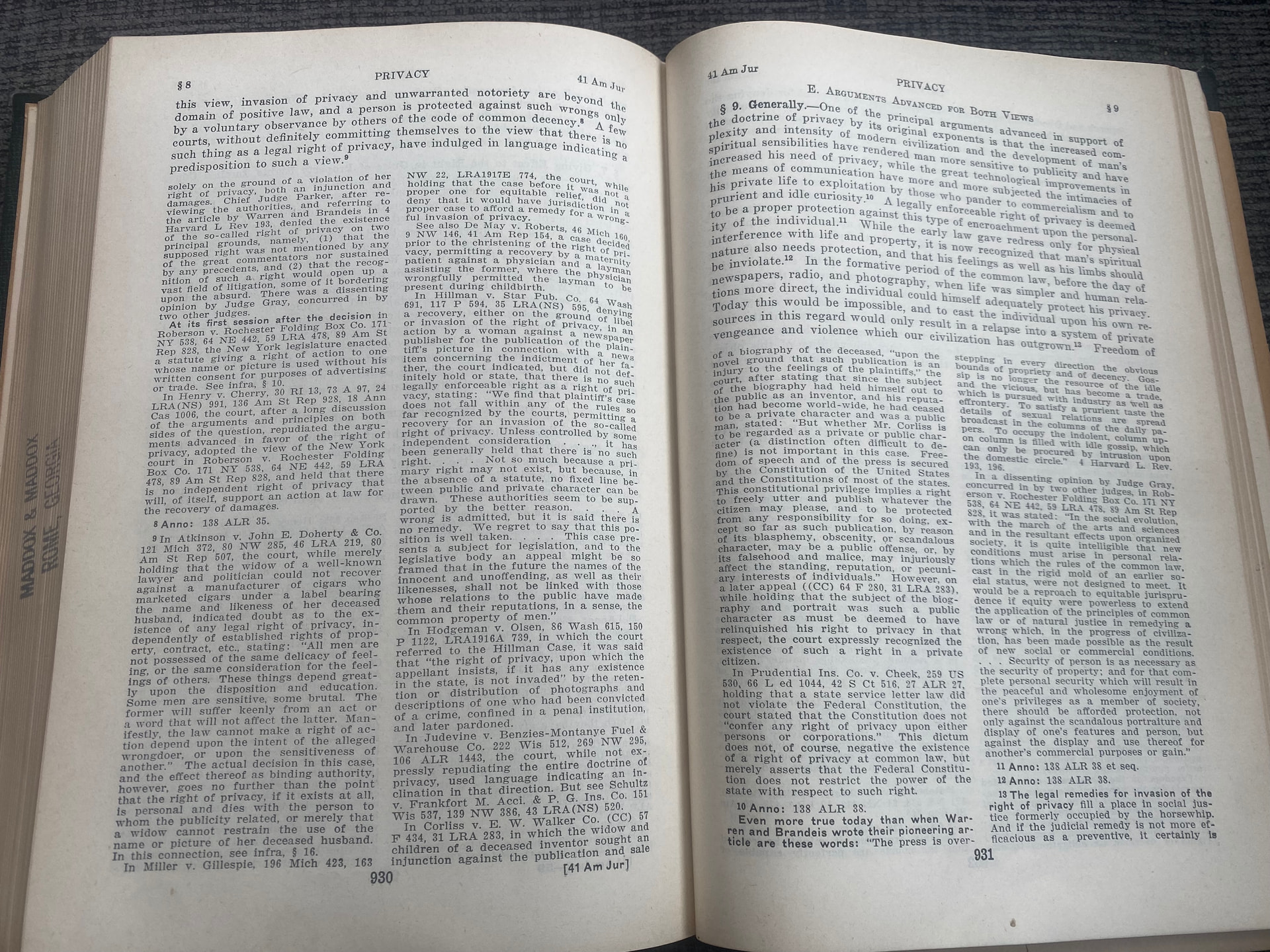
this view, invasion of privacy and unwarranted notoriety are beyond the domain of positive law, and a person is protected against such wrongs only by a voluntary observance by others of the code of common decency.⁸ A few courts, without definitely committing themselves to the view that there is no such thing as a legal right of privacy, have indulged in language indicating a predisposition to such a view.⁹

While there can be little doubt of the desirability or of the ultimate correctness of the results reached by the courts in cases in which they have given remedies for invasions of privacy on these familiar grounds, the attempt to force the right of privacy into some familiar mold and to base recovery upon some historically respectable ground tends to cast doubt upon the validity of the right itself, particularly to restrict its scope. Anno: 138 ALR 34, 35.

Even more true today than when Warren and Brandeis wrote their pioneering article are these words: "The press is overstepping in every direction the obvious bounds of propriety and of decency. Gossip is no longer the resource of the idle and of the vicious, but has become a trade, which is pursued with industry as well as effrontery. To satisfy a prurient taste the details of sexual relations are spread broadcast in the columns of the daily papers. To occupy the indolent, column upon column is filled with idle gossip, which can only be procured by intrusion upon the domestic circle." 4 Harvard L. Rev. 193, 196.

In a dissenting opinion by Judge Gray, joined by two other judges, in Roberson v. Rochester Folding Box Co. 171 NY 538, 64 NE 442, 59 LRA 478, 89 Am St Rep 828, it was said: "It was in the social evolution and in the march of the business conditions must arise intelligible that new conditions which the rules of the common law, framed in the right mold of an earlier social status, were not fit by requiring others to observe it, and to abstain from its violation."

Security of person is as necessary as the security of property, and for that complete personal security which will enable one to enjoy in peace and wholesome manner of living in one's privileges as a member of society, there should be afforded protection not only against the scandalous portraiture and display of one's features and person, but against the display and use thereof for another's commercial purposes or gain.¹⁰

¹⁰ Anno: 138 ALR 38 et seq.

### E. Arguments Advanced for Both Views

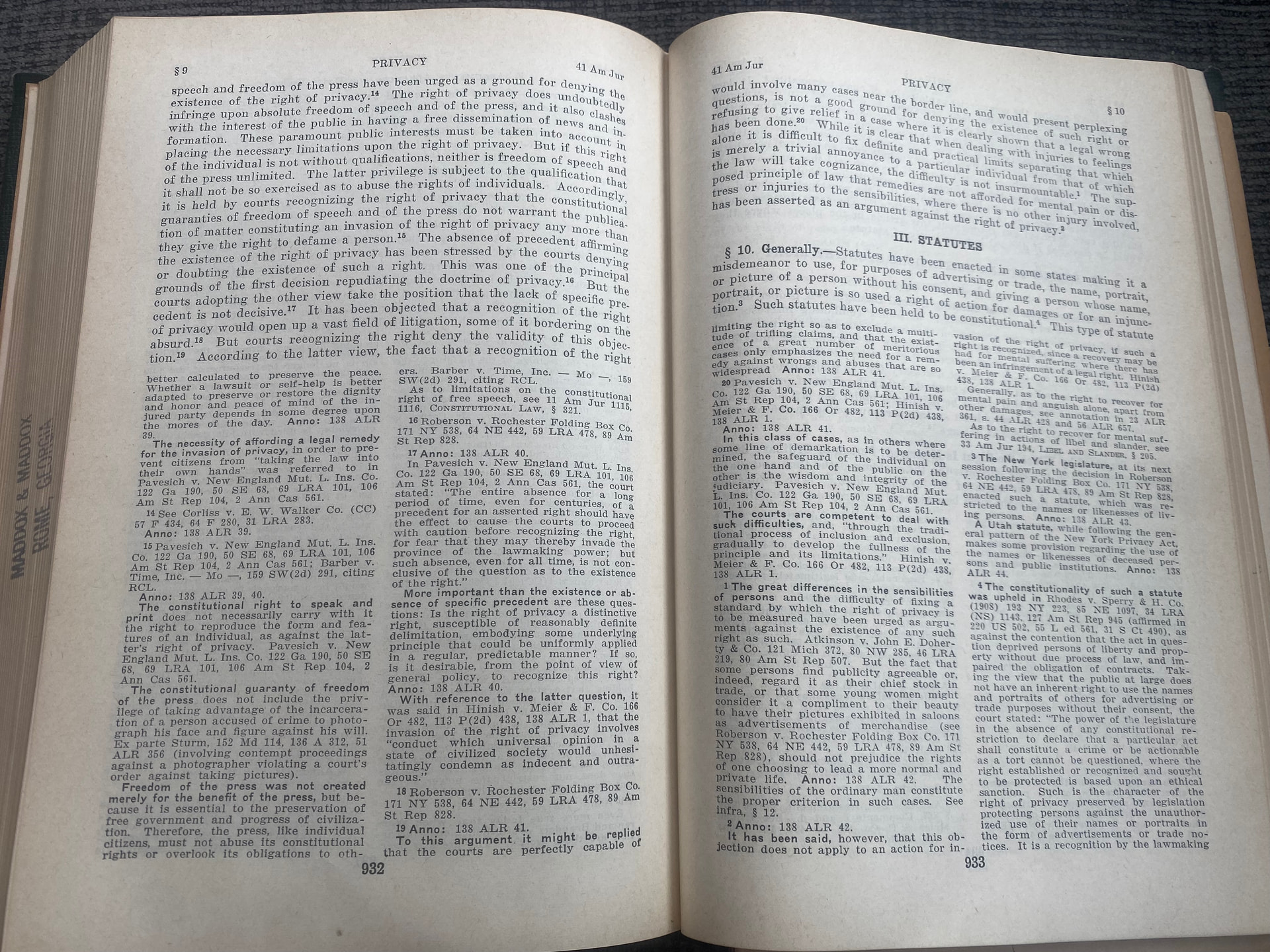
**§ 9. Generally.** — One of the principal arguments advanced in support of the doctrine of privacy by its original exponents is that the increased complexity and intensity of modern civilization and the development of man's spiritual sensibilities have rendered man more sensitive to publicity and have increased his need of privacy, while the great technological improvements in the means of communication have made more and more subjective the intimacies of his private life to exploitation by those who pander to commercial curiosity, and to a proper protection against this type of encroachment upon the individuality of the individual.¹¹ While the early law gave redress only for physical interference with life and property, it is now recognized that man's spiritual nature also needs protection, and that his feelings as well as his limbs should be inviolate.¹² In the formative period of the common law, before the day of newspapers, radio, and photography, when life was simpler and human relations more direct, the individual could himself adequately protect his privacy. Today this would be impossible, and to cast the individual upon his own resources in this regard would only result in a relapse into a system of private vengeance and violence which our civilization has outgrown.¹³ Freedom of speech and freedom of the press have been urged as a ground for denying the existence of the right of privacy.¹⁴ The right of privacy does undoubtedly infringe upon absolute freedom of speech and of the press, and it also clashes with the interest of the public in having a free dissemination of news and information. These paramount public interests must be taken into account in placing the necessary limitations upon the right of privacy. But if this right of the individual is not without qualifications, neither is freedom of speech and of the press unlimited. The latter privilege is subject to the qualification that it shall not be so exercised as to abuse the rights of individuals. Accordingly, it is held by courts recognizing the right of privacy that the constitutional guaranties of freedom of speech and of the press do not warrant the publication of matter constituting an invasion of the right of privacy any more than they give the right to defame a person.¹⁵ The absence of precedent affirming the existence of the right of privacy has been stressed by the courts denying or doubting the existence of such a right. This was one of the principal grounds of the first decision repudiating the doctrine of privacy.¹⁶ But the courts adopting the other view take the position that the lack of specific precedent is not decisive.¹⁷ It has been objected that a recognition of the right of privacy would open up a vast field of litigation, some of it bordering on the absurd.¹⁸ But courts recognizing the right deny the validity of this objection.¹⁹ According to the latter view, the fact that a recognition of the right

would involve many cases near the border line, and would present perplexing questions, is not a good ground for denying the existence of such right or refusing to give relief in a case where it is clearly shown that a legal wrong has been done.²⁰ While it is clear that when dealing with injuries to feelings alone it is difficult to fix definite and practical limits separating that which is merely a trivial annoyance to a particular individual from that which the law will take cognizance, the difficulty is not insurmountable. The supposed principle of law that remedies are not afforded for mental pain or distress or injuries to the sensibilities, where there is no other injury involved, has been asserted as an argument against the right of privacy.³

¹¹ Anno: 138 ALR 38 et seq. ¹² Anno: 138 ALR 24. ¹³ Anno: 138 ALR 24, 25. ¹⁴ See Roberson v. Rochester Folding Box Co. 171 NY 538, 64 NE 442, 59 LRA 478, 89 Am St Rep 828. ¹⁵ Anno: 138 ALR 39, 40. ¹⁶ Roberson v. Rochester Folding Box Co. 171 NY 538, 64 NE 442, 59 LRA 478, 89 Am St Rep 828. Anno: 138 ALR 40. ¹⁷ In Pavesich v. New England Mut. L. Ins. Co. 122 Ga 190, 50 SE 68, 69 LRA 101, 106 Am St Rep 104, 2 Ann Cas 561, the court stated: "The absence of a precedent for an asserted right should have the effect to cause the courts to proceed with caution before recognizing the right, for fear that they may thereby invade the province of the lawmaking power; but such absence, even for all time, is not conclusive of the question as to the existence of the right." ¹⁸ Roberson v. Rochester Folding Box Co. 171 NY 538, 64 NE 442, 59 LRA 478, 89 Am St Rep 828. ¹⁹ Anno: 138 ALR 41. ²⁰ Anno: 138 ALR 41.

More important than the existence or absence of specific precedent are these questions: Is the right of privacy a sufficiently definite right, susceptible of reasonably definite delimitation, embodying some underlying principle that could be uniformly applied in a regular, predictable manner? If so, is it desirable, from the point of view of general policy, to recognize this right? Anno: 138 ALR 40.

The constitutional right to speak and print does not necessarily carry with it the right to reproduce the form and features of an individual, as against the latter's right of privacy. Pavesich v. New England Mut. L. Ins. Co. 132 Ga 190, 50 SE 68, 69 LRA 101, 106 Am St Rep 104, 2 Ann Cas 561.

The constitutional guaranty of freedom of the press does not include the privacy of a person accused of crime to photograph his face and figure against his will. Ex parte Sturm, 152 Md 114, 136 A 312, 51 ALR (involving contempt proceedings against a photographer violating a court's order against taking pictures).

Freedom of the press was not created merely for the benefit of the press, but because it is essential to the preservation of free government and progress of civilization. Therefore, the press, like individual citizens, must not abuse its constitutional rights or overlook its obligations to others. Barber v. Time, Inc. — Mo —, 159 SW(2d) 291, citing RCL.

The necessity of affording a legal remedy for the invasion of privacy, in order to prevent citizens from "taking the law into their own hands" was referred to in Pavesich v. New England Mut. L. Ins. Co. 122 Ga 190, 50 SE 68, 69 LRA 101, 106 Am St Rep 104, 2 Ann Cas 561.

¹⁴ See Corliss v. E. W. Walker Co. (CC) 57 F 434, 64 F 280, 31 LRA 283. ¹⁵ Anno: 138 ALR 39, 40.

---

## III. STATUTES

**§ 10. Generally.** — Statutes have been enacted in some states making it a misdemeanor to use, for purposes of advertising or trade, the name, portrait, or picture of a person without his consent, and giving a person whose name, portrait, or picture is so used a right of action for damages or for an injunction.² Such statutes have been held to be constitutional.⁴ This type of statute

limiting the right so as to exclude a multitude of trifling claims, and that the existence of a great number of meritorious cases only emphasizes the need for a remedy against wrongs and abuses that are so widespread Anno: 138 ALR 41.

¹ Anno: 138 ALR 41. ² Pavesich v. New England Mut. L. Ins. Co. 122 Ga 190, 50 SE 68, 69 LRA 101, 106 Am St Rep 104, 2 Ann Cas 561; Hinish v. Meier & F. Co. 166 Or 482, 113 P(2d) 438, 138 ALR 1. Anno: 138 ALR 41. ³ Anno: 138 ALR 41. ⁴ The constitutionality of such a statute (1903) 193 NY 223, 55 NE 1097, 34 LRA (NS) 1143, 121 Am St Rep 945 (affirmed in 198 US 45, 25 S Ct 539, 49 L ed 946), as against the contention that the act in question deprived persons of liberty and property without due process of law, and impaired the obligation of contracts. Taking the view that the act in question did not have an inherent right to use the names and portraits of other individuals for advertising or trade purposes without their consent, the court stated: "The power of the legislature in the absence of any constitutional restriction is to declare that a particular act shall constitute a crime or be actionable as a tort cannot be questioned, where the right established or recognized and sought to be protected is based upon some public sanction. Such is the character of the right of privacy preserved by legislation protecting persons against the unauthorized use of their names or portraits in the form of advertisements or trade notices. It is a recognition by the lawmaking

---

## IV. EXTENT OF AND LIMITATIONS UPON THE RIGHT

### A. In General

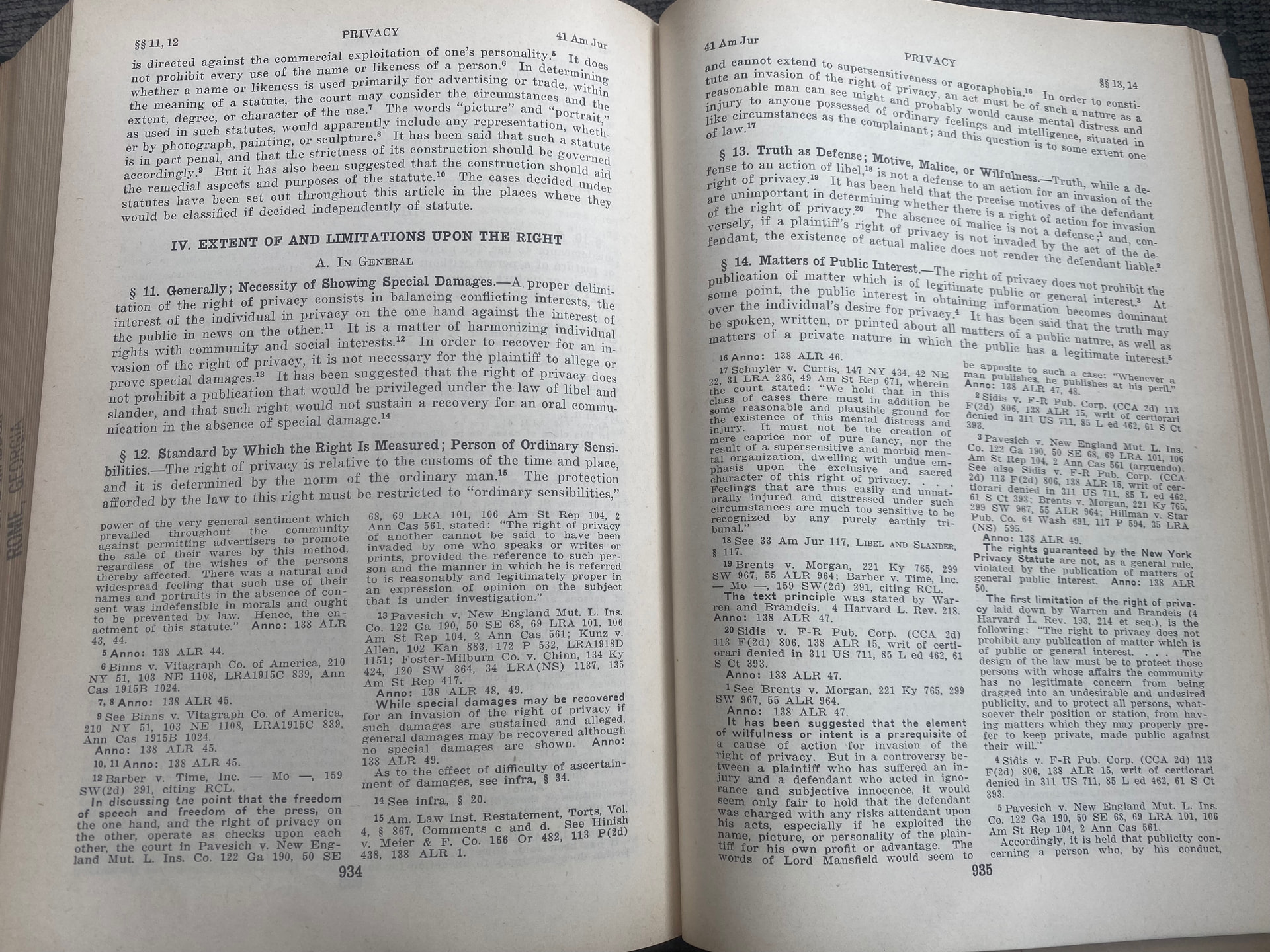
**§ 11. Generally; Necessity of Showing Special Damages.** — A proper delimitation of the right of privacy consists in balancing conflicting interests, the interest of the individual in privacy on the one hand against the interest of the public in news on the other.¹¹ It is a matter of harmonizing individual rights with community and social interests.¹² In order to recover for an invasion of the right of privacy, it is not necessary for the plaintiff to allege or prove special damages.¹³ It has been suggested that the right of privacy does not prohibit a publication that would be privileged under the law of libel and slander, and that such right would not sustain a recovery for an oral communication in the absence of special damage.¹⁴

is directed against the commercial exploitation of one's personality.⁵ It does not prohibit every use of the name or likeness of a person.⁶ In determining whether a name or likeness is used primarily for advertising or trade, within the meaning of a statute, the court may consider the circumstances and the extent, degree, or character of the use.⁷ The words "picture" and "portrait," as used in such statutes, would apparently include any representation, whether by photograph, painting, or sculpture.⁸ It has been said that such a statute is in part penal, and that the strictness of its construction should be governed accordingly.⁹ But it has also been suggested that the construction should aid the remedial aspects and purposes of the statute.¹⁰ The cases decided under statutes have been set out throughout this article in the places where they would be classified if decided independently of statute.

⁵ Anno: 138 ALR 44. ⁶ Binns v. Vitagraph Co. of America, 210 NY 51, 103 NE 1108, LRA1915C 839, Ann Cas 1915B 1024. ⁷ Anno: 138 ALR 45. ⁸ Anno: 138 ALR 45. ⁹ Binns v. Vitagraph Co. of America, 210 NY 51, 103 NE 1108, LRA1915C 839, Ann Cas 1915B 1024. ¹⁰ Anno: 138 ALR 45. ¹¹ Barber v. Time, Inc. — Mo —, 159 SW(2d) 291, citing RCL. ¹² Anno: 138 ALR 45. ¹³ It is not necessary, in discussing the point that the freedom of speech and the right of privacy, on the one hand, and freedom of the press, operate as checks upon each other, the court in Pavesich v. New England Mut. L. Ins. Co. 122 Ga 190, 50 SE stated: "The right of privacy of another cannot be said to have been invaded by one who speaks or prints, provided the matter to which reference is made to such person and the manner in which he is referred to is reasonably and legitimately proper in an expression of opinion on the subject then under investigation." ¹⁴ See infra, § 20. ¹⁵ Pavesich v. New England Mut. L. Ins. Co. 122 Ga 190, 50 SE 68, 69 LRA 101, 106 Am St Rep 104, 2 Ann Cas 561; Kunz v. Allen, 102 Kan 883, 172 P 532, LRA1918D 1151; Foster-Milburn Co. v. Chinn, 134 Ky 424, 120 SW 364, 34 LRA(NS) 1137, 135 Am St Rep 417. Anno: 138 ALR 48, 49.

While special damages may be recovered for an invasion of the right of privacy if the invasion was sustained and alleged, general damages may be recovered although no special damages are shown. Anno: 138 ALR 49.

As to the effect of difficulty of ascertainment of damages, see infra, § 34.

**§ 12. Standard by Which the Right Is Measured; Person of Ordinary Sensibilities.** — The right of privacy is relative to the customs of the time and place, and it is determined by the norm of the ordinary man.¹⁶ The protection afforded by the law to this right must be restricted to "ordinary sensibilities,"

and cannot extend to supersensitiveness or agoraphobia.¹⁶ In order to constitute an invasion of the right of privacy, an act must be of such a nature as a reasonable man can see might and probably would cause mental distress and injury to anyone possessed of ordinary feelings and intelligence, situated in like circumstances as the complainant; and this question is to some extent one of law.¹⁷

¹⁶ Anno: 138 ALR 46. ¹⁷ Schuyler v. Curtis, 147 NY 434, 42 NE 22, 31 LRA 286, 49 Am St Rep 671, the court stated: "The right of privacy of another cannot be said to have been invaded by one who speaks or writes or prints, provided the matter to which reference to such person and the manner in which he is referred to is reasonably and legitimately proper in an expression of opinion on the subject then under investigation." Anno: 138 ALR 47.

In discussing the point that the freedom of speech and the right of privacy, on the one hand, and freedom of the press, operate as checks upon the other, the court in Pavesich v. New England Mut. L. Ins. Co. 122 Ga 190, 50 SE stated: "The right of privacy of another cannot be said to have been invaded by one who speaks or prints, provided the matter to which reference is made to such person and the manner in which he is referred to is reasonably and legitimately proper in an expression of opinion on the subject then under investigation."

It has been suggested that the element of wilfulness or intent is a prerequisite of a cause of action for invasion of the right of privacy. But in a controversy between a plaintiff who suffered an injury and a defendant who acted in ignorance and subjective innocence, it would seem only fair to hold that the defendant was charged with any risks attendant upon his acts, especially if he exploited the name, picture, or personality of the plaintiff for his own profit or advantage. The words of Lord Mansfield would seem to

**§ 13. Truth as Defense; Motive, Malice, or Wilfulness.** — Truth, while a defense to an action of libel,¹⁸ is not a defense to an action for an invasion of the right of privacy.¹⁹ It has been held that the precise motives of the defendant are unimportant in determining whether there is a right of action for invasion of the right of privacy.²⁰ The absence of malice is not a defense;¹ and, conversely, if a plaintiff's right of privacy is invaded by the act of the defendant, the existence of actual malice does not render the defendant liable.²

¹⁸ See 33 Am Jur 117, LIBEL AND SLANDER, § 117. ¹⁹ Brents v. Morgan, 221 Ky 765, 299 SW 967, 55 ALR 964; Barber v. Time, Inc. — Mo —, 159 SW(2d) 291, citing RCL. ²⁰ The text principle was stated by Warren and Brandeis. 4 Harvard L Rev 213. Anno: 138 ALR 47. ¹ Sidis v. F-R Pub. Corp. (CCA 2d) 113 F(2d) 806, 138 ALR 15, writ of certiorari denied in 311 US 711, 85 L ed 462, 61 S Ct 393. Anno: 138 ALR 47. ² See Brents v. Morgan, 221 Ky 765, 299 SW 967, 55 ALR 964.

The first limitation of the right of privacy laid down by Warren and Brandeis (4 Harvard L. Rev. 193, 214 et seq.), is the following: "The right to privacy does not prohibit any publication of matter which is of public or general interest. The design of the law must be to protect those persons with whose affairs the community has no legitimate concern, from being dragged into an undesirable and undesired publicity, and to protect all persons, whatsoever their position or station, from having matters which they may properly prefer to keep private, made public against their will."

**§ 14. Matters of Public Interest.** — The right of privacy does not prohibit the publication of matter which is of legitimate public or general interest.³ At some point, the public interest in obtaining information becomes dominant over the individual's desire for privacy.⁴ It has been said that the truth may be spoken, written, or printed about all matters of a public nature, as well as matters of a private nature in which the public has a legitimate interest.⁵

be apposite to such a case: "Whenever a man publishes, he publishes at his peril."

³ Pavesich v. New England Mut. L. Ins. Co. 122 Ga 190, 50 SE 68, 69 LRA 101, 106 Am St Rep 104, 2 Ann Cas 561; Sidis v. F-R Pub. Corp. (CCA 2d) 113 F(2d) 806, 138 ALR 15 (arguendo). ⁴ Anno: 138 ALR 47. ⁵ Sidis v. F-R Pub. Corp. (CCA 2d) 113 F(2d) 806, 138 ALR 15, writ of certiorari denied in 311 US 711, 85 L ed 462, 61 S Ct 393. Anno: 138 ALR 47.

The rights guaranteed by the New York Privacy statute are not, as a general rule, violated by the publication of matters of general public interest. Anno: 138 ALR 49.

---

### B. Who May Assert the Right

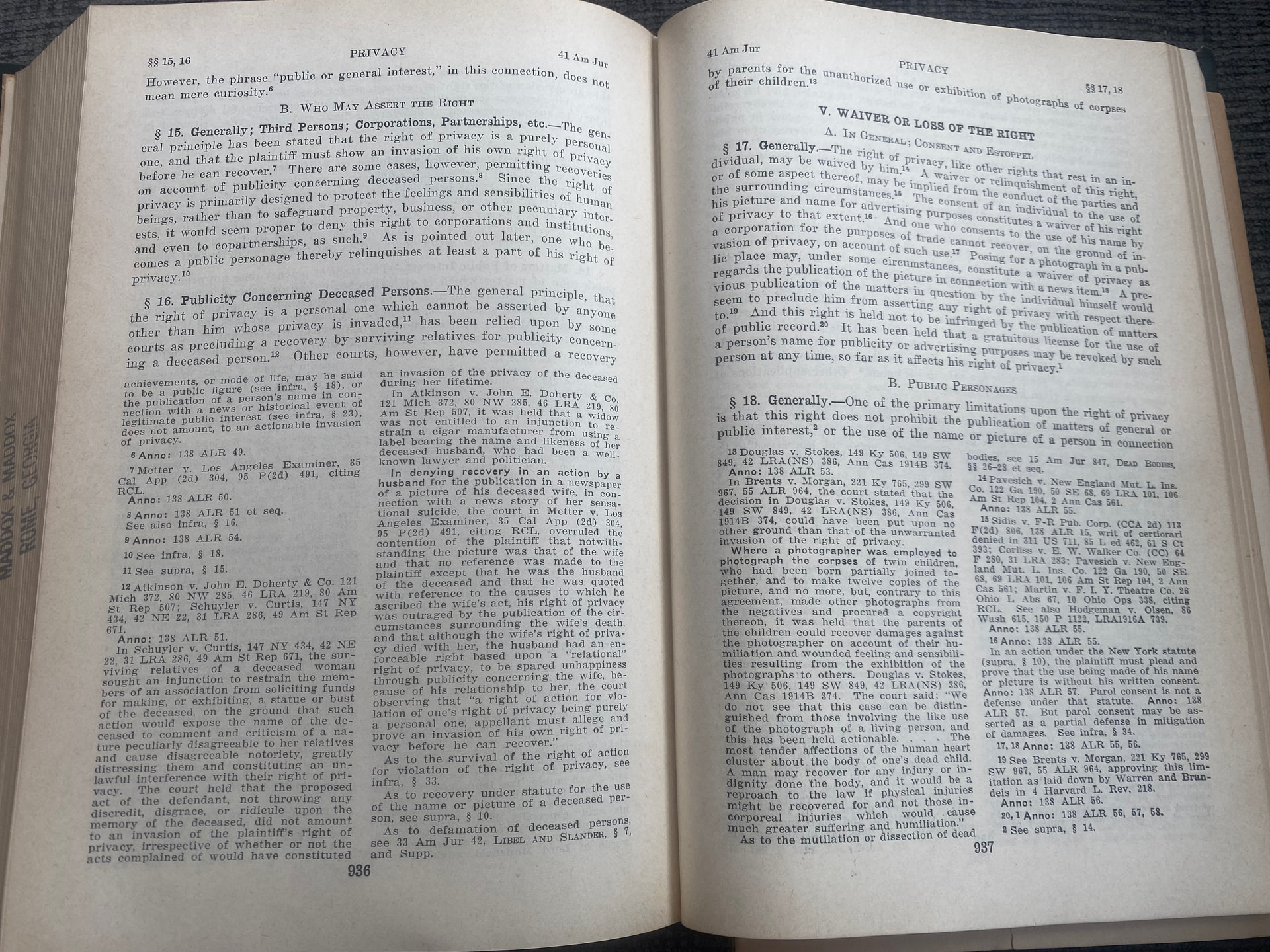
**§ 15. Generally; Third Persons; Corporations, Partnerships, etc.** — The general principle has been stated that the right of privacy is a purely personal one, and that the plaintiff must show an invasion of his own right of privacy before he can recover.⁷ There are some cases, however, permitting recoveries on account of publicity concerning deceased persons.⁸ Since the right of privacy is primarily designed to protect the feelings and sensibilities of human beings, rather than to safeguard property, business, or other pecuniary interests, it would seem proper to deny this right to corporations and institutions, and even to copartnerships, as such.⁹ As is pointed out later, one who becomes a public personage thereby relinquishes at least a part of his right of privacy.¹⁰

⁶ Anno: 138 ALR 49. ⁷ Metter v. Los Angeles Examiner, 85 Cal App (2d) 304, 95 P(2d) 491, citing RCL. Anno: 138 ALR 50. ⁸ Anno: 138 ALR 51 et seq. ⁹ Anno: 138 ALR 54. ¹⁰ See infra, § 18. ¹¹ See supra, § 15.

**§ 16. Publicity Concerning Deceased Persons.** — The general principle, that the right of privacy is a personal one which cannot be asserted by anyone other than him whose privacy is invaded,¹¹ has been relied upon by some courts as precluding a recovery by surviving relatives for publicity concerning a deceased person.¹² Other courts, however, have permitted a recovery

In Atkinson v. John E. Doherty & Co. 121 Mich 372, 80 NW 285, 46 LRA 219, 80 Am St Rep 507, it was held that a widow was not entitled to an injunction to restrain a cigar manufacturer from using a label bearing the name and likeness of her deceased husband, who had been a well-known lawyer and politician.

In denying recovery in an action by a husband for the publication in a newspaper of a picture of his deceased wife, in connection with a news story concerning her intentional suicide, the court in Metter v. Los Angeles Examiner, 35 Cal App (2d) 304, 95 P(2d) 491, citing RCL, overruled the contention of the plaintiff that notwithstanding the picture was that of the wife and that no reference was made to the name of the deceased and that he was quoted with reference to the causes to which he ascribed the wife's act, his right of privacy was outraged by the publication of the circumstances surrounding the wife's death, and that although the wife's right of privacy died with her, the husband had an enforceable right, based upon a "relational" right of privacy, to be spared unhappiness through publicity concerning the wife, because of his relationship to her, the court observing that "a right of privacy being purely a personal one, appellant must allege and prove an invasion of his own right of privacy before he can recover."

As to the survival of the right of action for violation of the right of privacy, see § 33.

As to recovery under statute for the use of the name or picture of a deceased person, see supra, § 10.

As to defamation of deceased persons, see 33 Am Jur 42, LIBEL AND SLANDER, § 7, and Supp.

¹² Anno: 138 ALR 51. ¹³ by parents for the unauthorized use or exhibition of photographs of corpses of their children.¹³

---

## V. WAIVER OR LOSS OF THE RIGHT

### A. In General; Consent and Estoppel

**§ 17. Generally.** — The right of privacy, like other rights that rest in an individual, may be waived by him.¹⁴ A waiver or relinquishment of this right, or of some aspect thereof, may be implied from the conduct of the parties and the surrounding circumstances.¹⁵ The consent of an individual to the use of his picture and name for advertising purposes constitutes a waiver of his right of privacy to that extent.¹⁶ And one who consents to the use of his name by a corporation for the purposes of trade cannot recover, on the ground of invasion of privacy, on account of such use.¹⁷ Posing for a photograph in a public place may, under some circumstances, constitute a waiver of privacy as regards the publication of the picture in connection with a news item.¹⁸ A previous publication of the matters in question by the individual himself would seem to preclude him from asserting any right of privacy with respect thereto.¹⁹ And this right is held not to be infringed by the publication of matters of public record.²⁰ It has been held that a gratuitous license for the use of a person's name for publicity or advertising purposes may be revoked by such person at any time, so far as it affects his right of privacy.¹

¹⁴ Anno: 138 ALR 55. ¹⁵ Anno: 138 ALR 55. ¹⁶ Anno: 138 ALR 55. ¹⁷ Anno: 138 ALR 55. ¹⁸ Anno: 138 ALR 55. ¹⁹ Anno: 138 ALR 55. ²⁰ Anno: 138 ALR 55. ¹ Anno: 138 ALR 56.

name and likeness from respectful use by other members of the community.

It has been said that the text principles apply to "those belonging to the learned professions, who, by their calling, place themselves before the public and thereby consent that their private lives may be determined for the purpose of determining whether it is to the interest of those whose patronage they seek to place their interests in their hands." Pavesich v. New England Mut. L. Ins. Co. 122 Ga 190, 50 SE 68, 69 LRA 101, 106 Am St Rep 104, 2 Ann Cas 561.

### B. Public Personages

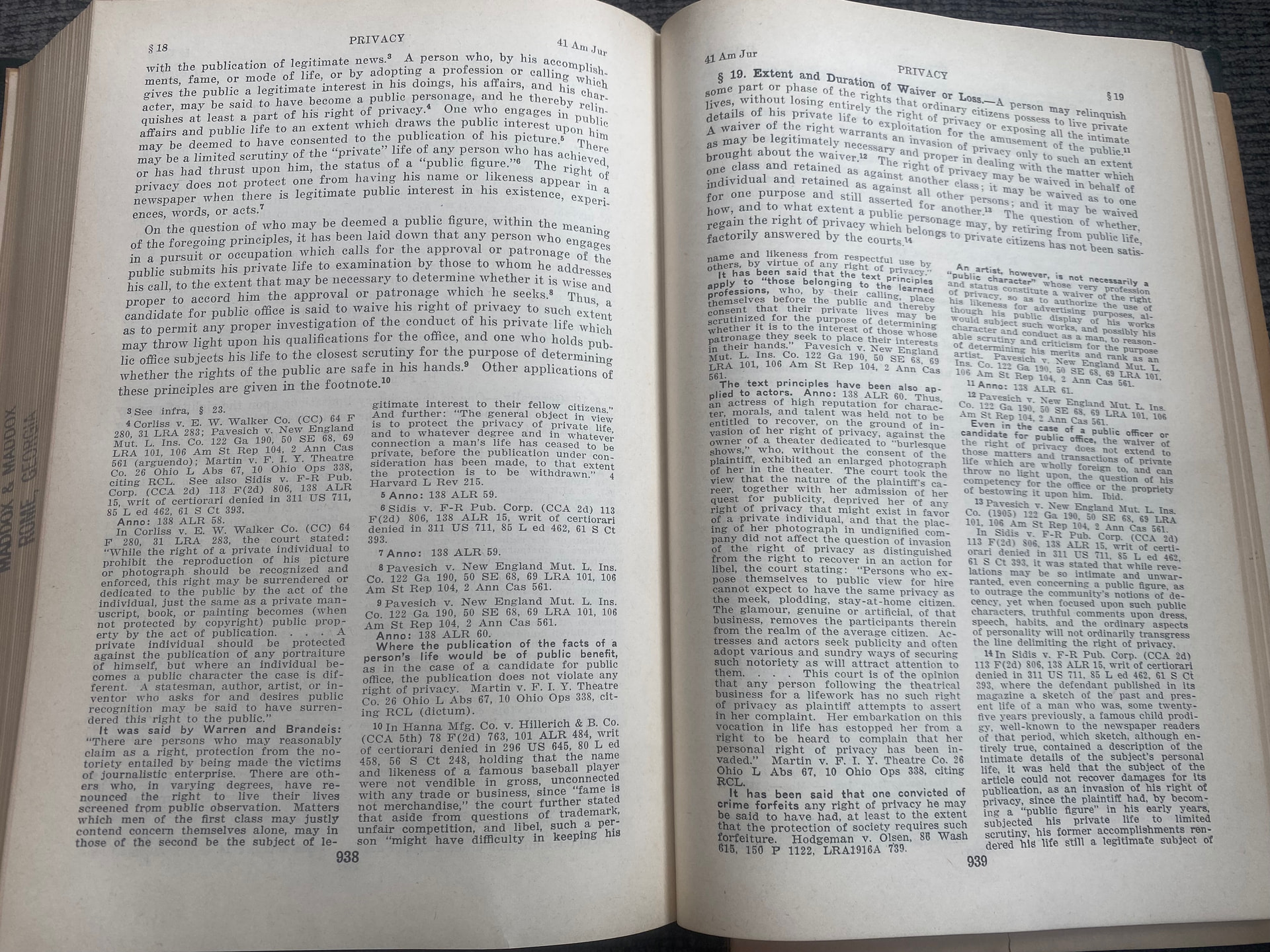
**§ 18. Generally.** — One of the primary limitations upon the right of privacy is that this right does not prohibit the publication of matters of general or public interest,² or the use of the name or picture of a person in connection with the publication of legitimate news.³ A person who, by his accomplishments, fame, or mode of life, or by adopting a profession or calling which gives the public a legitimate interest in his doings, his affairs, and his character, may be said to have become a public personage, and he thereby relinquishes at least a part of his right of privacy.⁴ One who engages in public affairs and public life to an extent which draws the public interest upon him may be deemed to have consented to the publication of his picture.⁵ There may be a limited scrutiny of the "private" life of any person who has achieved, or has had thrust upon him, the status of a "public figure."⁶ The right of privacy does not protect one from having his name or likeness appear in a newspaper when there is legitimate public interest in his existence, experiences, words, or acts.

On the question of who may be deemed a public figure, within the meaning of the foregoing principles, it has been laid down that any person who engages in a pursuit or occupation which calls for the approval or patronage of the public submits his private life to examination by those to whom he addresses his call, to the extent that may be necessary to determine whether it is wise and proper to accord him the approval or patronage which he seeks.⁸ Thus, a candidate for public office is said to waive his right of privacy to such extent as to permit any proper investigation of the conduct of his private life which may throw light upon his qualifications for the office, and one who holds public office subjects his life to the closest scrutiny for the purpose of determining whether the rights of the public are safe in his hands.⁹ Other applications of these principles are given in the footnote.¹⁰

It was said by Warren and Brandeis: "There are others who, in varying degrees, have renounced the right to live their lives screened from public observation. Matters which men of the first class may justly concern themselves alone, may in those of the second be the subject of legitimate interest to their fellow citizens."

And further: "The general object in view is to protect the privacy of private life, and whatever degree and in whatever connection a man's life has ceased to be private, before the publication under consideration has been made, to that extent the protection is to be withdrawn." 4 Harvard L Rev 215.

² See supra, § 14. ³ Anno: 138 ALR 58. ⁴ In Corliss v. E. W. Walker Co. (CC) 64 F 280, 31 LRA 283, the court stated: "While the right of a private individual to prohibit the reproduction of his picture should be recognized and enforced, this right may be surrendered or dedicated to the public by the act of the individual, just the same as a private painting or portrait by making a public (when not protected by copyright) public property by the act of publication. . . . A private individual should be protected against the publication of any portraiture of himself, but where an individual becomes a public character the case is different. A statesman, author, artist, or inventor, who asks or desires public recognition may be said to have surrendered this right to the public." ⁵ Anno: 138 ALR 59. ⁶ Sidis v. F-R Pub. Corp. (CCA 2d) 113 F(2d) 806, 138 ALR 15, writ of certiorari denied in 311 US 711, 85 L ed 462, 61 S Ct 393. ⁷ Anno: 138 ALR 59. ⁸ Pavesich v. New England Mut. L. Ins. Co. 122 Ga 190, 50 SE 68, 69 LRA 101, 106 Am St Rep 104, 2 Ann Cas 561. ⁹ Pavesich v. New England Mut. L. Ins. Co. 122 Ga 190, 50 SE 68, 69 LRA 101, 106 Am St Rep 104, 2 Ann Cas 561. ¹⁰ Anno: 138 ALR 60.

Where the publication of the facts of a person's life would be of public benefit, as in the case of a candidate for public office, the publication does not violate any right of privacy. Martin v. F. I. Y. Theatre Co. 26 Ohio L Abs 67, 10 Ohio Ops 338, citing RCL.

It has been said that one convicted of crime forfeits any right of privacy he may be said to have had, at least to the extent that the protection of society requires an examination of his record. Hodgeman v. Olsen 88 Wash 615, 150 P 1122, LRA1916A 739.

**§ 19. Extent and Duration of Waiver or Loss.** — A person may relinquish some part or phase of the rights that ordinary citizens possess to live private details of his private life to the right of privacy or exposing all the intimate details of his private life to exploitation for the amusement of the public.¹¹ A waiver of the right warrants an invasion of privacy only to such an extent as may be legitimately necessary and proper in dealing with the matter which brought about the waiver.¹² The right of privacy may be waived in behalf of one individual and retained as against another class; it may be waived as to one for one purpose and still asserted for another;¹³ and it may be waived how, and to what extent a public personage may, by retiring from public life, regain the right of privacy which belongs to private citizens has not been satisfactorily answered by the courts.¹⁴

An artist, however, is not necessarily a "public character" whose very profession opens the door to privacy, so as to authorize the use of his likeness for advertising purposes, though his public performances and his works may be subject to public criticism and comment, and he may submit himself to reasonable and unjust criticism of such works, and may publish his own name and rank in connection with them, as a man, to reasonable scrutiny and criticism for the purpose of determining his merits and rank as an artist. Pavesich v. New England Mut. L. Ins. Co. 122 Ga 190, 50 SE 68, 69 LRA 101, 106 Am St Rep 104, 2 Ann Cas 561.

¹² Pavesich v. New England Mut. L. Ins. Co. 122 Ga 190, 50 SE 68, 69 LRA 101, 106 Am St Rep 104, 2 Ann Cas 561. ¹³ Sidis v. F-R Pub. Corp. (CCA 2d) 113 F(2d) 806, 138 ALR 15, writ of certiorari denied in 311 US 711, 85 L ed 462, 61 S Ct 393. ¹⁴ Anno: 138 ALR 2, 2 Ann Cas 561.

Even in the case of a public official or candidate for public office, the waiver of those matters and transactions of private life which are wholly foreign to, and have no bearing on, the question of his fitness or competency for the office, or the propriety of bestowing it upon him. Ibid.

---

## VI. WHAT CONSTITUTES VIOLATION OF THE RIGHT

### A. In General

**§ 20. Generally.** — A legal remedy can be afforded, in practice, only for the more flagrant breaches of decency and propriety.¹⁵ The rule has been laid down that a communication of even a private matter does not violate the right of privacy, when the publication would be a privileged communication under the principles governing libel and slander.¹⁶ And the further limitation has been suggested that there can be no recovery for an invasion of privacy by any oral publication, in the absence of special damage.¹⁷ However, the fact that the person violating privacy has not published or disclosed the means or results of such violation has been held not to prevent an action therefor.¹⁸

¹⁵ Anno: 138 ALR 63. ¹⁶ Anno: 138 ALR 63. ¹⁷ Anno: 138 ALR 63. ¹⁸ Anno: 138 ALR 63.

As to privilege of communications in libel and slander, see 33 Am Jur 123, LIBEL AND SLANDER, §§ 124 et seq.

### B. Use of Name or Likeness

**§ 21. Generally.** — The unwarranted publication of a person's name,¹⁹ or the unauthorized use or publication of his photograph or other likeness,²⁰ constitutes the most common means of invasion of the right of privacy.¹ The sale of photographs of the plaintiff,² the unwarranted publication of the plaintiff's picture in a newspaper,³ the unauthorized exhibition of an X-ray picture showing a part of the plaintiff's body or of pictures showing the performance of an operation upon the plaintiff or the effects of disease upon the plaintiff's appearance,⁴ or the publication of the name and picture of a woman in bed in a hospital, in connection with a story concerning her unusual ailment,⁵ has been held to violate the right of privacy. Some courts have permitted a recovery for the unauthorized use or publication of the plaintiff's likeness on the ground of infringement of contract or property rights.⁶ Courts adopting

public comment, and his subsequent history, as it did the answer to the question of whether or not he had fulfilled his early promise, was still a man of public concern, notwithstanding the fact that he had a passion for privacy, had developed a discomfort with the divulgence of his career, an insignificant clerk, making no use of his genius, and, until the publication of the article in question, had apparently succeeded in his endeavor to avoid the public gaze. Another court, however, has permitted a recovery by a reformed prostitute on account of the making and showing of a motion picture depicting her former life. See annotation in 138 ALR 63, 85.

¹⁵ Anno: 138 ALR 63. ¹⁶ See Brents v. Morgan, 221 Ky 765, 299 SW 967, 55 ALR 964, approving 4 Harvard Rev. 217. ¹⁷ Anno: 138 ALR 63. ¹⁸ Anno: 138 ALR 63. ¹⁹ Hinish v. Meier & F Co. 166 Or 482, 113 P(2d) 438, 138 ALR 1. ²⁰ Anno: 138 ALR 63. ¹ Anno: 138 ALR 63. ² Anno: 138 ALR 63. ³ Anno: 138 ALR 63. ⁴ Anno: 138 ALR 63. ⁵ Barber v. Time, Inc. — Mo —, 159 SW(2d) 291, citing RCL. ⁶ Anno: 138 ALR 63.

In Moore v. Rugg, 44 Minn 28, 46 NW 141, 9 LRA 58, 20 Am St Rep 539, a woman who employed a photographer to make a photograph of herself was held to be entitled to recover damages against a photographer whom she had employed to make her photograph, and who, in the performance of this work, made other copies of it, displayed the photograph to the public for advertising purposes, in McCreery v. Miller's Groceteria Co. 99 Colo 499, 64 P(2d) 803, citing RCL, on the theory that the photographer had willfully breached his contract with the plaintiff and that the grocer had induced the breach and conspired with the photographer to display the goods, with knowledge of the plaintiff's contract with the photographer. Anno: 138 ALR 75.

¹³ Anno: 138 ALR 75. ¹⁴ Anno: 138 ALR 77.

In Foster-Milburn Co. v. Chinn, 134 Ky 424, 120 SW 364, 34 LRA(NS) 1137, 135 Am St Rep 417 (later appeal in 137 Ky 834, 127 SW 476), a drug manufacturing company which published in a booklet advertising its products, a picture of a prominent citizen, together with a skeletonized life and a forged letter falsely stating that such person had used the pills and recommended them, was held to be liable in damages to such person. The court, apparently taking the view that the publication in question constituted libel if it subjected the plaintiff to ridicule or contempt, but the court also expressly recognized the right of plaintiff to recover for the breach of his right of privacy, stating: "While there is some conflict in the authorities, we concur with those holding that a person has a legal right as to his picture, and that the publication of the picture of a person without his consent, as a part of an advertisement for the commercial use of the publisher's business, is a violation of the right of privacy, and entitles him to recover without proof of special damages. . . . It has become a custom in the public to publish pictures of prominent people, but it is a very different thing for a manufacturer to use without authority such a man's picture to advertise his goods in connection with a forged letter indorsing the goods."

The inadequacy of the relief granted on the basis of property rights (see supra, § 7) is demonstrated by the results reached by the English courts, which have denied relief to physicians whose names were used without their authority in pretended rec-

**§ 22. Use for Advertising or Trade Purposes.** — The exploitation of another's personality for commercial purposes constitutes one of the most flagrant and common means of invasion of privacy. In jurisdictions recognizing the right of privacy, the unauthorized use of a person's name¹ or picture¹⁵ for advertising purposes is held to constitute an invasion of the right of privacy.

photograph of herself was held to be entitled to recover damages against a photographer whom she had employed to make her photograph and who subsequently, without the consent of the plaintiff, made other copies from the negative, on the ground that the photographer had impliedly agreed that the negative should be used only for making such portraits as the plaintiff might order or authorize.

The inadequacy of the protection afforded by property rights and other recognized remedies for breach of contract, violation of property rights, etc., is illustrated in cases involving photographs of the plaintiff. In such cases, the principles of implied contract and the rule against authorized publication thereof, but these principles would not extend to the victim of an unauthorized photograph. Yet the desirability and need of a legal remedy would seem to be as clear in one case as in the other. Anno: 138 ALR 1. As has been pointed out, "both cases are concerned primarily with an indignity offered to the plaintiff's personality, and the only difference is that in the one a fiction is available which is wanting in the other." Hinish v. Meier & F. Co. 166 Or 482, 113 P(2d) 438, 138 ALR 1.

See supra, § 8.

¹ See supra, § 7.

⁸ Anno: 138 ALR 63.

In Pavesich v. New England Mut. L. Ins. Co. 122 Ga 190, 50 SE 68, 69 LRA 101, 106 Am St Rep 104, 2 Ann Cas 561, the court stated: "The entire doctrine of invasions of the right of privacy indicates an inclination in that direction." But see Schultz v. Frankfort M. Accl. & P. G. Ins. Co. 151 Wis 537, 139 NW 386, 43 LRA(NS) 520.

In E. W. Walker Co. (CC) 57 F, in which the widow and children of a deceased inventor sought an injunction against the publication and sale of a biography of the deceased, "upon the ground that such publication is an injury to the feelings of the plaintiffs," the court, after stating that since the subject of the biography had held himself out to the public as an inventor, and his reputation had become world-wide, he had ceased to be a private character and was a public man, stated: "But whether Mr. Corliss is to be regarded as a private or public character (a distinction often difficult to fine) is not important in this case. Freedom of speech and of the press is secured by the Constitution of the United States and the Constitutions of most of the states. This necessarily implies a right to freely utter and publish whatever any citizen may please, and to be protected from any responsibility for so doing, except so far as such publication, in cases of its blasphemy, obscenity, or scandalous character, may be a public offense, or, by its falsehood and malice, may injuriously affect the standing, reputation, or pecuniary interests of individuals." However, on the appeal (CC) 64 F 280, 31 LRA 283), while holding that the subject was such a public character as must be deemed to have relinquished his privacy in that respect, the court expressly recognized the existence of such a right in a private citizen.

In Prudential Ins. Co. v. Cheek, 259 US 530, 66 L ed 1044, 42 S Ct 516, 27 ALR 27, holding that a state service letter law did not violate the Federal Constitution, the court stated that the Constitution does not "confer any right of privacy upon either persons or corporations." This dictum does not, of course, negative the existence of a right of privacy at common law, but merely asserts that the Federal Constitution does not put the power of the state with respect to such right.

¹⁰ Anno: 138 ALR 38 et seq. ¹¹ Anno: 138 ALR 38 et seq. ¹² Anno: 138 ALR 24. ¹³ The legal remedies for invasion of the right of privacy fill a place in social justice formerly occupied by the horsewhip. And if the judicial remedy is more of a formality as a preventive, it certainly is

**§ 23. Use in Connection with News or Historical Event.** — As pointed out above, the right of privacy is subject to the qualifications that the publication of matters of legitimate public concern is not inhibited,¹¹ and a person may, by his acts, achievements, or mode of life become a public character, and therefore his name or picture in connection with a news or historical event of legitimate public interest does not constitute an actionable invasion of the right of privacy.¹⁸ Upon the same principles, it is settled that the publication of a person's name or picture in connection with a news or historical event of legitimate public interest does not constitute an actionable invasion of the right of privacy.¹⁹ A person who commits some act of great notoriety or who, whether willingly or not, becomes an actor in an occurrence of public or general interest, thereby relinquishes his right of privacy to the extent that his name and picture may be published in connection with an account of the event.²⁰ The publication of a person's name or portrait in connection with such news or historical events does not give the person a right of action under a statute prohibiting the use of a person's name or picture for the purposes of advertising or trade without his consent.¹ It is not the purpose of such statutes to stop the dissemination of news as a business in itself or as an adjunct to the sale of advertising, and they do not prohibit the use of a name or picture in properly recounting or portraying an actual event of current public interest, as is commonly done in a single issue of a regular newspaper.²

ommendations and advertisements of "patent" medicines. Anno: 138 ALR 77.

¹⁵ See supra, § 8. ¹⁶ Roberson v. Rochester Folding Box Co. 171 NY 538, 64 NE 442, 59 LRA 478, 89 Am St Rep 828; Henry v. Cherry, 30 RI 13, 73 A 97, 24 LRA(NS) 991, 136 Am St Rep 928, 18 Ann Cas 1006. ¹⁷ Anno: 138 ALR 78. ¹⁸ Anno: 138 ALR 77, 78. ¹⁹ Anno: 138 ALR 77, 78. ²⁰ Anno: 138 ALR 78.

Where a photographer was employed to photograph the corpses of twin children, who had been born partially joined together, and to make twelve copies of the picture, and no more, but contrary to this agreement, made other photographs from the negatives and printed copies of the picture thereon, it was held that the parents of the children could recover damages against the photographer on account of their humiliation and wounded feeling and sensibilities resulting from the exhibition of the photographs to others. Douglas v. Stokes, 149 Ky 506, 149 SW 849, 42 LRA(NS) 386, Ann Cas 1914B 374. The court said: "We do not see that this case can be distinguished from those involving the like use of the photograph of a living person. The most tender affections of the human heart cluster about the body of one's dead child. A man may recover for any injury or indignity to the body. It would be a reproach to the law if physical injuries might be recovered for and not those incorporeal injuries which would cause much greater suffering and humiliation." As to the mutilation or dissection of dead

¹ See supra, § 10. ² Anno: 138 ALR 78.

a newspaper publisher for the publication of her picture in connection with a front page news item relating to the indictment of her father by a Federal grand jury, and actually deciding the question, the court indicated that there was no such right as the right of privacy.

³ Anno: 138 ALR 78.

Where the plaintiff's husband, while walking, was attacked and stabbed to death, and the plaintiff attacked and struck the persons as they made their escape, the publication in a newspaper of an account of the incident, accompanied by pictures of the plaintiff and her husband, was held not to violate the plaintiff's right of privacy. Jones v. Herald Post Co. 230 Ky 227, 18 SW(2d) 972, citing RCL.

By committing suicide by leaping from a public building, a woman was held to have become temporarily an object of public interest, and to have waived any right to keep her picture from public observation from the position in parturition, or by publishing an account of her suicide, so as to preclude an action by her husband, based on violation of any right of privacy, in connection with the publication of her picture. Metter v. Los Angeles Examiner (1939) 35 Cal App (2d) 304, 95 P(2d) 491, citing RCL.

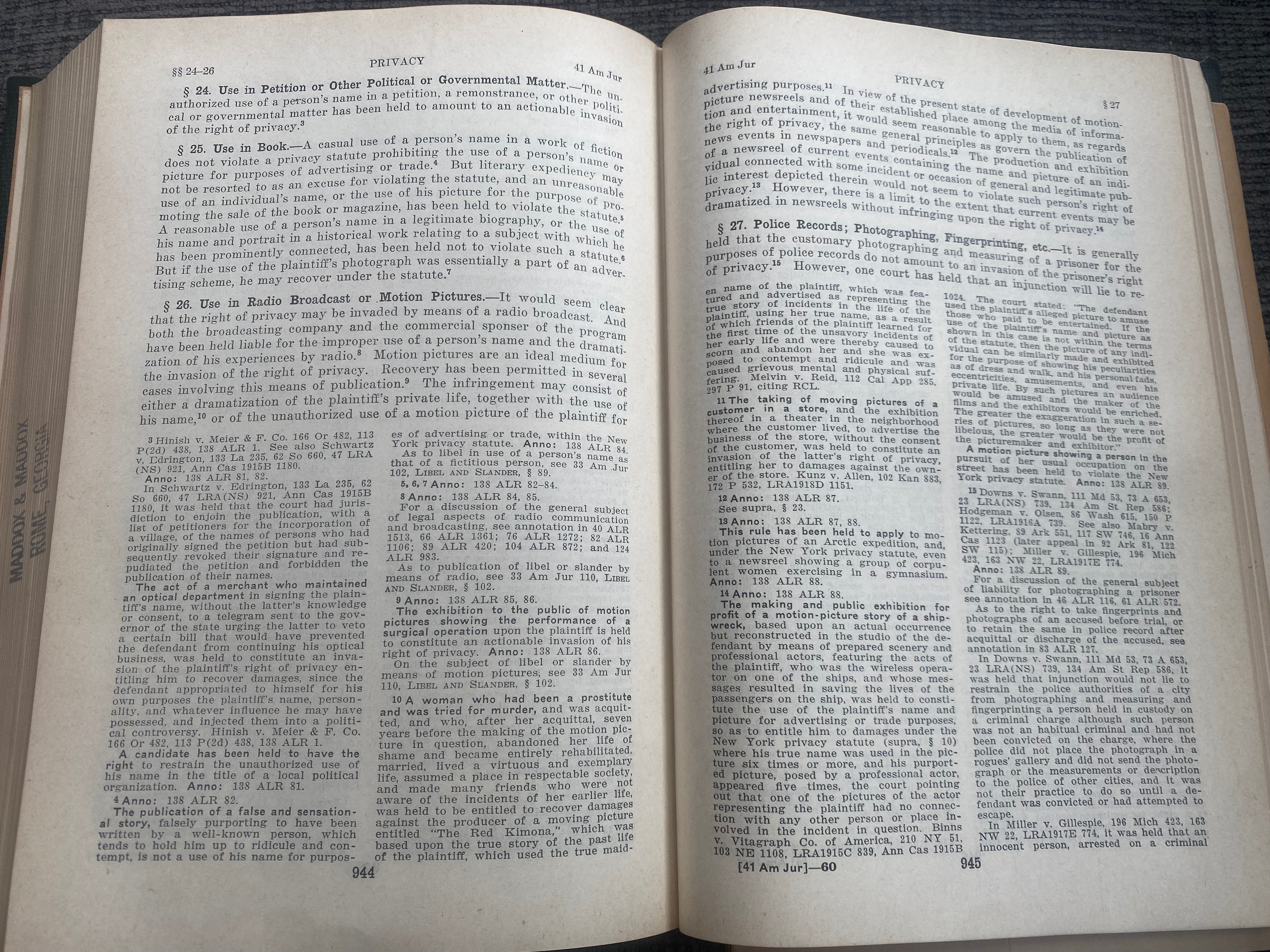
**§ 24. Use in Petition or Other Political or Governmental Matter.** — The unauthorized use of a person's name in a petition, a remonstrance, or other political or governmental matter has been held to amount to an actionable invasion of the right of privacy.³

³ Hinish v. Meier & F. Co. 166 Or 482, 113 P(2d) 438, 138 ALR 1.

**§ 25. Use in Book.** — A casual use of a person's name in a work of fiction does not violate a privacy statute prohibiting the use of a person's name or picture for purposes of advertising or trade.⁴ But literary expediency may not be resorted to as an excuse for violating the statute, and an unreasonable use of an individual's name, or the use of his picture for the purpose of promoting the sale of the book or magazine, has been held to violate the statute.⁵ A reasonable use of a person's name in a legitimate biography, or the use of his name and portrait in a historical work relating to a subject with which he has been prominently connected, has been held not to violate such a statute.⁶ But if the use of the plaintiff's photograph was essentially a part of an advertising scheme, he may recover under the statute.⁷

³ Anno: 138 ALR 81. ⁴ Hinish v. Meier & F. Co. 166 Or 482, 113 P(2d) 438, 138 ALR 1. See also Schwartz v. Edrington, 133 La 235, 62 So 660, 47 LRA (NS) 921, Ann Cas 1915B 1180; Vanderbilt v. Mitchell, 72 NJ Eq 910, 67 A 97, 14 LRA (NS) 304; Holloman v. Life Ins. Co. of Va. 192 SC 454, 7 SE(2d) 169, 127 ALR 110 (arguendo). ⁵ Anno: 138 ALR 81, 82. ⁶ Anno: 138 ALR 82. ⁷ Anno: 138 ALR 82. ⁸ Anno: 138 ALR 84, 85.

For a discussion of the general subject of rights as to aspects of radio communication and broadcasting, see annotation in 40 ALR 1513, 66 ALR 1361; 76 ALR 1272; 82 ALR 1106; 89 ALR 420; 104 ALR 940; and 124 ALR 1.

**§ 26. Use in Radio Broadcast or Motion Pictures.** — It would seem clear that the right of privacy may be invaded by means of a radio broadcast. And both the broadcasting company and the commercial sponsor of the program have been held liable for the improper use of a person's name and the dramatization of his experiences by radio.⁸ Motion pictures are an ideal medium for the invasion of the right of privacy. Recovery has been permitted in several cases involving this means of publication.⁹ The infringement may consist of either a dramatization of the plaintiff's private life, together with the use of his name,¹⁰ or of the unauthorized use of a motion picture of the plaintiff for

advertising purposes.¹¹ In view of the present state of development of motion-picture newsreels and of their entertainment, it would seem reasonable to apply to them, as regards the right of privacy, the same general principles as govern the publication of a newsreel of current events containing the name and picture of an individual connected with some incident or occurrence of general and legitimate public interest depicted therein.¹³ However, there is a limit to the extent that current events may be dramatized in newsreels without infringing upon the right of privacy.¹⁴

⁹ Anno: 138 ALR 85. ¹⁰ Anno: 138 ALR 85. ¹¹ Anno: 138 ALR 85, 86. ¹² The making and public exhibition for profit of a motion-picture story of a shipwreck, based upon an actual experience, but reconstructed in the studio of the defendant by means of prepared scenery and including the actual transactions, featuring the acts of the plaintiff, who was the wireless operator on one of the ships, and whose messages resulted in saving the lives of the passengers of the ship, was held to constitute the use of the plaintiff's name and picture for advertising or trade purposes, so as to entitle him to damages under the New York privacy statute (supra, § 10), where his true name was used in the picture six times or more, and his purported picture, posed by a professional actor, appeared five times, the court pointing out that it was the pictures of the plaintiff's name and picture shown so often as to entitle the defendant to damages. Binns v. Vitagraph Co. of America, 210 NY 51, 103 NE 1108, LRA1915C 839, Ann Cas 1915B 1024. ¹³ Anno: 138 ALR 88. ¹⁴ Anno: 138 ALR 88.

The exhibition to the public of motion pictures showing the performance of a surgical operation upon the plaintiff is held to constitute an actionable invasion of the right of privacy. Anno: 138 ALR 86.

On the subject of libel or slander by means of motion pictures, see 33 Am Jur 110, LIBEL AND SLANDER, § 102.

A woman who had been a prostitute and was tried for murder, and was acquitted, and who, after her acquittal, seven years before the making of the motion picture in question, abandoned her life of shame, became entirely rehabilitated, married, lived a virtuous and exemplary life, assumed a place in respectable society, and made many friends who were not aware of the incidents of her earlier life, was held to be entitled to recover damages against the producer of a moving picture entitled "The Red Kimono," which was based upon the true story of the past life of the plaintiff, which used the true maid-

**§ 27. Police Records; Photographing, Fingerprinting, etc.** — It is generally held that the customary photographing and measuring of a prisoner for the purposes of police records do not amount to an invasion of the prisoner's right of privacy.¹⁵ However, one court has held that an injunction will lie to re-

en name of the plaintiff, which was featured and advertised as representing the true story of incidents in the life of the plaintiff, using her true name, as a result of which friends of the plaintiff learned for the first time of the incidents of her early life and were thereby caused to abandon the career of the plaintiff and to shun her, and exposed her to contempt and ridicule, was held to constitute an invasion of the right of privacy, and an injunction and damages were awarded. Melvin v. Reid, 112 Cal App 285, 297 P 91, citing RCL; Pavesich v. New England Mut. L. Ins. Co. 122 Ga 190, 50 SE 68, 69 LRA 101, 106 Am St Rep 104, 2 Ann Cas 561.

In Miller v. Gillespie, 196 Mich 423, 163 NW 22, LRA1917E 774, it was held that an innocent person, arrested on a criminal

strain police officers from taking the picture of an accused person and placing the same in a rogues' gallery and from sending copies thereof to similar galleries in other states, where such person has not been convicted of any crime and is not a fugitive from justice, and the necessity of taking and posting the picture is not made to appear.¹⁶

¹⁵ Anno: 138 ALR 89. ¹⁶ In Hodgeman v. Olsen, 86 Wash 615, 150 P 1122, LRA1916A 739, it was held that since the persons in charge of the state penal institutions had the right, under the penal institutions law, to take and retain photographs, data measurements and other descriptive information of persons incarcerated in such institutions, one who had been so convicted and confined was not entitled to compel the superintendent of such institutions to destroy such pictures or to prevent their retention and speculation, since "the right of privacy, upon which the appellant in the state, if it has an existence in this state, is not invaded by such distribution."

The relation to the public of one who has been convicted of a crime is such as to be said to have forever lost whatever right of privacy he may have ever possessed. This is true, at least, to the extent that the protection of society requires the forfeiture of such pictures." Ibid.

For a discussion of mandamus to compel return or destruction of photographs, descriptions, etc., by public officers, see 34 Am Jur 953, MANDAMUS, § 180.

**§ 28. Assumption of Another's Name or Title; Impersonation.** — The false impersonation of a person for the purpose of obtaining business or trade secrets has been held to constitute an invasion of such person's right of privacy.¹⁷ And the assumption of another's name without right has been enjoined as a violation of his personal rights.¹⁸

¹⁷ Anno: 138 ALR 91. ¹⁸ In Western U. Teleg. Co. v. Schimpf, 983 Ohio 910, 54 NE 487, holding that a man was entitled to an injunction against his wife, the latter's infant, and the superintendent of the bureau of vital statistics, to restrain the unwarranted use of the plaintiff's name as the father of the wife's child, on the ground that the child was an adulterine bastard, and that its use of the plaintiff's name was calculated to injure to risk or liability, the court, in placing its decision primarily upon the menace to the plaintiff's property rights, rather than upon the ground of violation of his personal rights stated: "If it appeared in this case that only the plaintiff's status and personal rights were thus threatened or thus invaded by the action of the defendants and by the filing of the false certificate, we should be of the view that an individual has, without question, the right to enforce in a court of equity and which a court of equity will enforce against invasion, and we should declare that the complainant was entitled to relief, and to a decree establishing the truth as to the paternity of plaintiff's children and thus relieving the complainant of the intolerable burden prima facie put upon him by the false record and preventing the wife from perpetrating a fraud upon the husband." In Schewe v. Goldman (CCA 2d) 113 F(2d) 310 (writ of certiorari granted in — US —, 86 L ed (Adv 87), 62 S Ct 119), said: "There was only an instance of eavesdropping, which alone, although an invasion of privacy, is not a violation of a recognized legal right of privacy."

---

### C. Eavesdropping; Wire Tapping

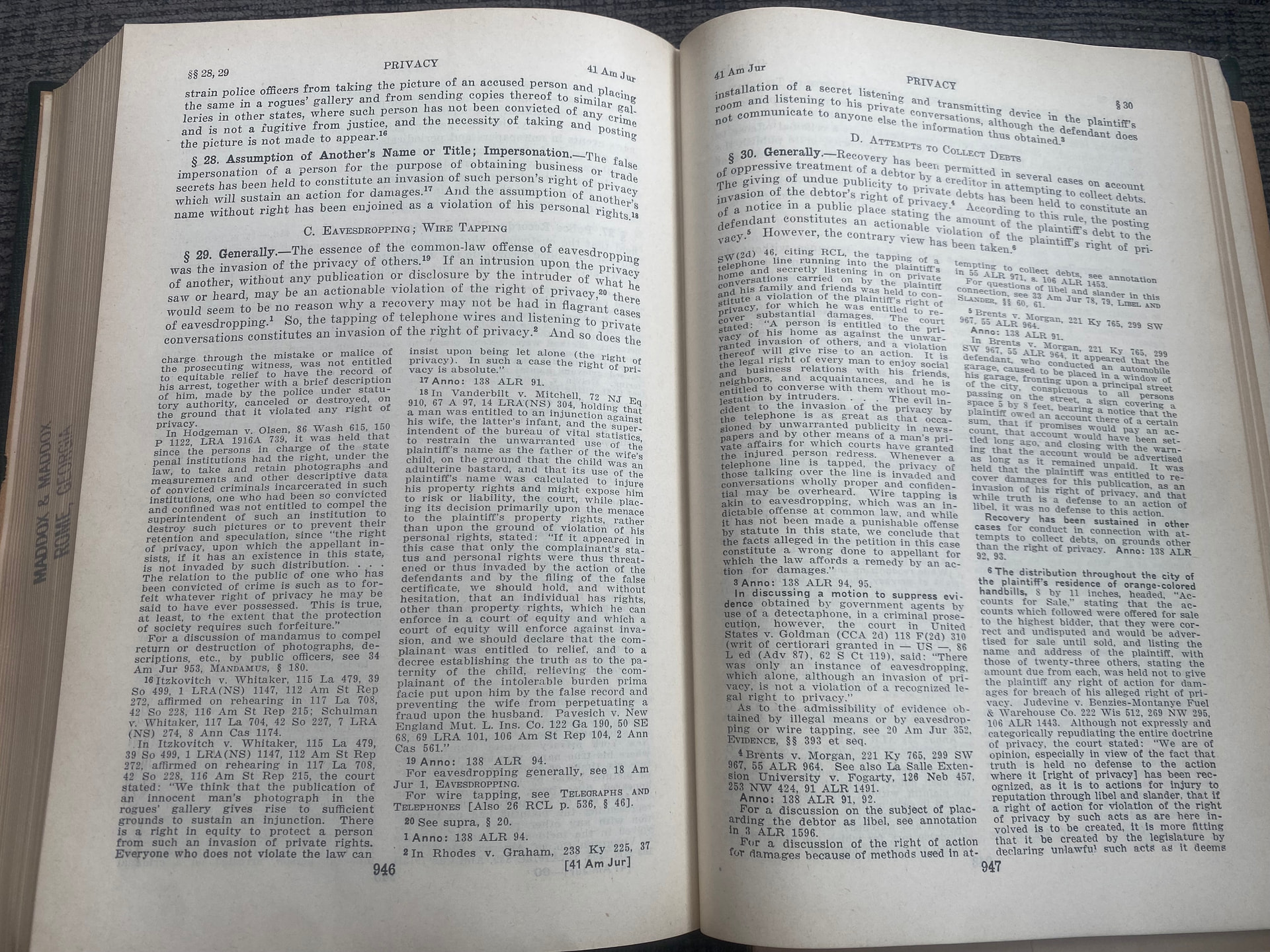
**§ 29. Generally.** — The essence of the common-law offense of eavesdropping was the invasion of the privacy of others.¹⁹ If an intrusion upon the privacy of another, without any publication or disclosure by the intruder of what he saw or heard, may be an actionable violation of the right of privacy, there would seem to be no reason why a recovery may not be had in flagrant cases of eavesdropping.²⁰ So, the tapping of telephone wires and listening to private conversations constitutes an invasion of the right of privacy.¹ And so does the installation of a secret listening and transmitting device in the plaintiff's room and listening to his private conversations, although the defendant does not communicate to anyone else the information thus obtained.²

¹⁹ Anno: 138 ALR 94. ²⁰ Anno: 138 ALR 94. ¹ Anno: 138 ALR 94, 95. ² In Rhodes v. Graham, 238 Ky 225, 37 SW(2d) 46, citing RCL.

charge through the mistake or malice of the prosecuting witness, was not entitled to equitable relief to have the record of him, made by the police, under statutory authority, cancelled, or destroyed, on the ground that it violated any right of privacy.

In Hodgeman v. Olsen, 86 Wash 615, 150 P 1122, LRA1916A 739, it was held that since the persons in charge of the state penal institutions had the right, under the penal institutions law, to take and retain photographs, data measurements and other descriptive information of persons incarcerated in such institutions, one who had been so convicted and confined was not entitled to compel the superintendent of such institutions to destroy such pictures or to prevent their retention and speculation, since "the right of privacy, upon which the appellant in the state, if it has an existence in this state, is not invaded by such distribution."

insist upon being let alone (the right of privacy). In such a case the right of privacy is absolute.¹⁷

¹⁷ Anno: 138 ALR 91. ¹⁸ In Vanderbilt v. Mitchell, 72 NJ Eq 910, 67 A 97, 14 LRA(NS) 304 (holding that a man was entitled to an injunction against his wife, the latter's infant, and the superintendent of the bureau of vital statistics, to restrain the unwarranted use of the plaintiff's name as the father of the wife's child, on the ground that the child was an adulterine bastard, and that its use of the plaintiff's name was calculated to injure the plaintiff to risk or liability, the court, placing its decision primarily upon the menace to plaintiff's property rights, rather than upon the ground of violation of his personal rights stated: "If it appeared in this case that only the plaintiff's status and personal rights were thus threatened or thus invaded by the action of the defendants and by the filing of the false certificate, we should be of the view that an individual has, without question, the right to enforce in a court of equity, and which a court of equity will enforce against invasion, and we should declare that the complainant was entitled to relief, and to a decree establishing the truth as to the paternity of plaintiff's children and thus relieving the complainant of the intolerable burden prima facie put upon him by the false record and preventing the wife from perpetrating a fraud upon the husband." In Schewe v. Goldman (CCA 2d) 113 F(2d) 310 (writ of certiorari granted in — US —, 86 L ed (Adv 87), 62 S Ct 119), said: "There was only an instance of eavesdropping, which alone, although an invasion of privacy, is not a violation of a recognized legal right of privacy."

In discussing a motion to suppress evidence obtained by government agents by a system of detective shadowing in a criminal prosecution, however, the court in United States v. Goldman (CCA 2d) 310 113 F(2d) 310 (writ of certiorari granted in — US —, 86 L ed (Adv 87), 62 S Ct 119), said: "There was only an instance of eavesdropping, which alone, although an invasion of privacy, is not a violation of a recognized legal right of privacy."

As to the admissibility of evidence obtained by illegal means or by eavesdropping or wire tapping, see 20 Am Jur 352, EVIDENCE, §§ 393 et seq.

In Brents v. Morgan, 221 Ky 765, 299 SW 967, 55 ALR 964. See also La Salle Extension University v. Fogarty, 126 Neb 457, 253 NW 424, 91 ALR 1491. Anno: 138 ALR 91, 92.

For a discussion on the subject of locating the debtor as libel, see annotation in 3 ALR 1596.

For a discussion of the right of action for damages for methods used in at-

tempting to collect debts, see annotation in 55 ALR 1146.

---

### D. Attempts to Collect Debts

**§ 30. Generally.** — Recovery has been permitted in several cases on account of oppressive treatment of a debtor by a creditor in attempting to collect debts. The giving of undue publicity to private debts has been held to constitute an invasion of the debtor's right of privacy.³ According to this rule, the posting of a notice in a public place stating the amount of the plaintiff's debt to the defendant constitutes an actionable violation of the plaintiff's right of privacy.⁴ However, the contrary view has been taken.⁵

²A "person is entitled to the right of privacy against the unwarranted invasion of others, and a violation thereof will give rise to an action. The invaded man's social and business relations with his friends, neighbors, and acquaintances, and he is entitled to have them without molestation by intruders. The evil incident to the invasion of the plaintiff's privacy on several occasions by unwarranted publicity in newspapers and by other means of a man's private debts, and as a means of coercing him the injured person redress. Whenever a telephone line is tapped, the privacy of those talking over the line is invaded; the conversations wholly proper and confidential may be overheard." Wire tapping is akin to eavesdropping which was an indictable offense at common law, and it has not been made a punishable offense by statute, we are constrained to conclude that the facts alleged in the petition in this case constitute a wrong done to appellant for which the law affords a remedy by an action of damages."

³ Brents v. Morgan, 221 Ky 765, 299 SW 967, 55 ALR 964. ⁴ Anno: 138 ALR 94, 95. ⁵ Brents v. Morgan, 221 Ky 765, 299 SW 967, 55 ALR 964. See also La Salle Extension University v. Fogarty, 126 Neb 457, 253 NW 424, 91 ALR 1491. Anno: 138 ALR 91.

Recovery has been sustained in other cases for invasion of privacy in connection with attempts to collect debts, on grounds other than the right of privacy. Anno: 138 ALR 93.

The distribution throughout the city of orange-colored handbills, 8 by 11 inches, headed, "Accounts which I have for collection, together with the names, and amounts of twenty-three others, stating the amount due from each, was held not to give the plaintiff any right of action for damages for breach of his alleged right of privacy. Judevine v. Benzies-Montanye Fuel & Warehouse Co. 222 Wis 512, 269 NW 295, 106 ALR 1443. Although not expressly and categorically repudiating the entire doctrine of privacy, the court expressed the observation in connection with the newspaper observation in connection with the newspaper observation in connection with the newspaper observation in connection with the newspaper observation in view of the fact that truth is held no defense to the action where it [right of privacy] has been recognized, as it is to actions for injury to reputation through libel and slander, the line delimiting the right of privacy.

---

### E. Opening, Publishing, or Disclosing Contents of Letter or Telegram

**§ 31. Generally.** — On grounds closely analogous to the right of privacy, it is settled that the writer of a personal letter may enjoin its publication, even by the recipient.⁷ Some states have made it a criminal offense to license to open or read a sealed letter or telegram without authority, or to publish the contents of one so opened or read.⁸ While the courts generally recognize that telegraph companies owe a duty to keep secret the messages intrusted to them for transmission, the cases in which recovery is allowed for wrongful disclosure of such messages do not purport to be based upon a breach of the right of privacy.⁹

⁷ Grigsby v. Breckinridge, 2 Bush(Ky) 480, 92 Am Dec 509; Denis v. Leclerc, 1 Mart (La) 297, 5 Am Dec 712; Baker v. Libbie, 210 Mass 599, 97 NE 109, 37 LRA (NS) 944, Ann Cas 1912D 614. ⁸ Anno: LRA 1915C 437. ⁹ Holloman v. Life Ins. Co. of Va. 192 SC 454, 7 SE(2d) 169, 127 ALR 110.

The ground on which equity will enjoin the publication of private letters is generally said to be the property rights of the writer. Anno: Ann Cas 1912D 614.

In holding that the writer of a letter, could enjoin its unauthorized publication, the court in Denis v. Leclerc, 1 Mart (La) 297, 5 Am Dec 712, relied largely upon the Cicero of private correspondence, the "open malice of knavish accident or knavery may place his letter, cannot be compelled to reveal the secrets of these family secrets, the writer will innocently incur the odium of the conduct of the younger son of Noah. An injured wife may commit to paper, for the information of a parent, the cause of family disquietude; if the dishonest holder of a press may give publicity to the complaint, adieu to all her hopes of domestic felicity. If a merchant may communicate to his friend the danger of his situation, solicit a timely relief, which will certainly avert his ruin, the indiscretion or malice of the messenger may plunge him in the abyss, from which secrecy might have saved him."

For rights relating to letters generally, see 34 Am Jur 410–413, LITERARY PROPERTY AND COPYRIGHT, §§ 14–16.

⁵ State v. Bagwell, 107 NC 859, 12 SE 254, 9 LRA 840.

An indictment for reading and publishing the contents of a letter under a statute must charge that the letter was sealed and that its contents were published with the knowledge that it was opened and read without authority. Ibid.

---

### F. Miscellaneous

**§ 32. Generally.** — The issuance of a policy of life insurance without the consent of the insured has been held not to amount to a violation of his right of privacy.¹⁰ The "rough shadowing" of a person by detectives has been held to constitute a tort which will sustain an action for damages.¹¹ Another court,

While recognizing the existence of a legal right of privacy, held that the "rough shadowing" in connection with a commercial use of her nature, since she was not thereby subjected to unwarranted publicity, or to any publicity at all.

¹⁰ Holloman v. Life Ins. Co. of Va. 192 SC 454, 7 SE(2d) 169, 127 ALR 110. ¹¹ Schultz v. Frankfort M. Accl. & P. G. Ins. Co. 151 Wis 537, 139 NW 386, 43 LRA (NS) 520. ¹² Anno: 138 ALR 93, 94.

In Schultz v. Frankfort M. Accl. & P. G. Ins. Co. 151 Wis 537, 139 NW 386, 43 LRA (NS) 520, the "rough shadowing" (that is, the open, public, and persistent following of the plaintiff, without any attempt at secrecy and in such manner as to make obvious to the public that the plaintiff was being followed and watched) was held to be actionable tort, for which the plaintiff was entitled to recover damages.

The right of privacy secures one in the right to obtain medical treatment at home or in a hospital for an individual, personal condition, without personal publicity.¹² A physician has been held liable for bringing a layman into the room where a patient is confined in childbirth.¹³ While it is held that the owner from erecting or maintaining windows in a wall on the latter's land overlooking the premises of the former, unless he has safeguarded his privacy by deed or contract, it has been suggested that, under some circumstances, an overlooking window might be enjoined as a violation of the right of privacy.¹⁵ Recovery has been permitted in several cases involving intrusions in private apartments, in which the right violated was quite similar to the right of privacy.¹⁶ Of course, if the defendant has been guilty of trespass quare clausum, the courts find no difficulty in allowing damages for fright, mental suffering, shame, humiliation, and invasion of privacy. But in some of the cases, the right entitled to the privacy of his or her quarters, regardless of the question of ownership, it being held that a person is entitled to recover for verbal insults and abuse, and indecent or profane language, uttered in the hearing of a person, is fundamentally wrong; the courts have not considered the question in the light of the right of privacy.¹⁷ An individual has been held to have no right to recover against one who disturbs or annoys him by means of noise, in the absence of an invasion of property rights.¹⁸ It is generally held that while equity will restrain the disclosure of a trade secret obtained through employment, contract, or other confidential relations, it will not grant such remedy against one honestly coming into the possession of the secret who does not violate any contract or confidential relation.²⁰ The right of persons to be secure against unreasonable searches and seizures, granted by the several Constitutions, has been said to be an implied recognition of a right to privacy.¹ Also closely related to the right of privacy is the right to cultivate society to the extent desired by the individual.²

¹² Without expressing an opinion on the merits of any action the plaintiff might bring, the court in Chappell v. Stewart, 82 Md 323, 33 A 542, 37 LRA 753, 51 Am St Rep 476 (affirmed in 169 US 733, 42 L ed 1215, 18 S Ct 940), answering the question whether equity protects only property rights, and will not issue an injunction to protect purely personal rights, held that an injunction would not issue to restrain a defendant from continuing the employment of detectives to follow the plaintiff and watch him wherever he should go, although it was alleged that this conduct caused the plaintiff great inconvenience and annoyance, interfered with his social intercourse and business, and caused suspicions to be entertained about him, so as to damage his financial credit. No reference was made to any recognized right of privacy. ¹³ Barber v. Time, Inc. — Mo —, 159 SW(2d) 291, citing RCL. ¹⁴ Anno: 138 ALR 101. ¹⁵ Anno: 138 ALR 102. ¹⁶ Anno: 138 ALR 102. ¹⁷ Both this type of wrong and acts which violate the right of privacy offend the sensibilities of the victim without any physical contact with his person; both obtrude upon his peace of mind and produce mental pain or humiliation; and both tend to cause breaches of the peace. Anno: 138 ALR 103. ¹⁸ Anno: 138 ALR 103–105.

---

## VII. REMEDIES; DAMAGES; PROCEDURAL MATTERS

**§ 33. Generally.** — This division is intended to include only matter distinctive in some degree to the right of privacy. The nature and theory of the action based upon a violation of the right of privacy are discussed in another division.³ It has been held that the right of privacy is purely personal, and the right of action for its violation does not survive, but dies with the person whose privacy has been invaded.⁴ A cause of action for libel may be joined in the same complaint with one, based on the same publication, for violation of the New York privacy statute.⁵ The mere appearance of a person's name in a printed advertisement has been held to be insufficient to raise a presumption of authorship and to constitute no substantial evidence to carry to the jury, in an action for violation of the right of privacy, the question whether such person was responsible for the publication.⁶

²⁰ Anno: 12 LRA(NS) 102, s. 20 LRA(NS) 933, and 44 LRA(NS) 1160. ¹ Anno: 138 ALR 97. ² Anno: 138 ALR 99. ³ Anno: 138 ALR 99. ⁴ Anno: 138 ALR 97, 98.

Damages are recoverable for the mental suffering and humiliation produced by an unlawful search. Anno: 50 LRA(NS) 1151. See 17 Am Jur 1, DISCOVERY, INSPECTION, MENTAL AND PHYSICAL EXAMINATION.

¹ Anno: 138 ALR 99. ² Anno: 138 ALR 99.

In Deen v. Kirby Lumber Co. 162 La 671, 111 So 555, 51 ALR 1023, holding that one who, maliciously and with the intent of injuring the plaintiff's social standing and character, forbade and prevented his employees and their families from visiting the plaintiff and his family, and thus deprived the plaintiff and his family of the society of their friends and relations, was liable in damages to the plaintiff and his family, the court said: "It is the legal right of every man to enjoy social relations with his friends and neighbors. He is entitled to visit them and their families and to have them visit him and his family. The free and unhampered exercise of the right is necessary to his happiness, comfort, and well-being. If he be unlawfully deprived of that right by others, he is entitled to redress."

³ See supra, §§ 6, 7.

⁴ Metter v. Los Angeles Examiner, 35 Cal App (2d) 304, 95 P(2d) 491, citing RCL.

The right of action given by the New York privacy statute (see supra, § 10), has been held to be one for injury to the person of the plaintiff, and therefore one that dies with the person; but a suit based thereon, commenced by the injured party during her lifetime, does not abate, but may be revived by her administratrix after her death. Anno: 138 ALR 109, 110.

As to the right of surviving relatives to maintain an action on account of publicity concerning deceased persons, see supra, § 16.

⁵ Anno: 138 ALR 109.

⁶ Anno: 138 ALR 109.

It has been suggested that such a joinder would be proper in an action based upon common-law rights. Barber v. Time, Inc. — Mo —, 159 SW(2d) 834, 131 ALR 295.

**§ 34. Damages.** — One whose right of privacy is unlawfully invaded is entitled to recover substantial damages, although the only damages suffered by him resulted from mental anguish.⁷ In such an action, the damages to be recovered are those which the law authorizes in cases of torts of that character, and if the law authorizes a recovery for wounded feelings in other torts of a similar nature, such damages would be recoverable in an action for the violation of this right.⁸ The fact that in cases involving infringements of the right of privacy the damages may be difficult of ascertainment⁹ or cannot be measured by a pecuniary standard¹⁰ is not a good ground for denying any recovery. Punitive damages may be recovered for an invasion of the right of privacy, where the element of malice appears.¹¹ But a plaintiff seeking to recover punitive damages has the burden of proving malice on the part of the defendant.¹² A defendant in an action to recover for infringement of the right of privacy is entitled to set up and prove any facts which might be considered a complete defense.¹³

⁷ Rhodes v. Graham, 238 Ky 225, 37 SW(2d) 46, citing RCL; Brents v. Morgan, 221 Ky 765, 299 SW 967, 55 ALR 964. ⁸ Anno: 138 ALR 106. ⁹ Barber v. Time, Inc. — Mo —, 159 SW(2d) 291, citing RCL. ¹⁰ Anno: 138 ALR 106. ¹¹ Anno: 138 ALR 106.

In Chappell v. Stewart, 82 Md 323, 33 A 542, 37 LRA 753, 51 Am St Rep 476 (appeal dismissed in 169 US 733, 42 L ed 1215, 18 S Ct 940), the court, denying an injunction to restrain the defendants from employing detectives to shadow the plaintiff, proceeded on the theory that equity protects only property rights.

¹² Anno: 138 ALR 107.

¹³ Anno: 138 ALR 107.

It has been suggested that such a joinder would be proper in an action based upon common-law rights. Barber v. Time, Inc. — Mo —, 159 SW(2d) 834, 131 ALR 295.

As to mental pain and anguish as an element of damages generally, see 15 Am Jur 592, DAMAGES, §§ 175 et seq.

Hinish v. Meier & F. Co. 166 Or 482, 113 P(2d) 438, 138 ALR 1.

**§ 35. Injunction or Other Extraordinary Relief.** — It is frequently asserted as a general principle that equity has jurisdiction only to enforce or protect property rights, and has no jurisdiction where mere personal rights are involved.¹⁴ This is generally disapproved by legal commentators, and there is a growing tendency on the part of the courts to recognize and give equitable protection to personal rights, independently of any property rights.¹⁵ Some courts, in denying recovery in privacy cases, have referred to the supposed principle that equity grants relief only to protect property rights.¹⁶ But the right to an injunction to protect the right of privacy has been affirmed or recognized in a number of cases.¹⁸

¹⁴ Rhodes v. Graham, 238 Ky 225, 37 SW(2d) 46, citing RCL; Brents v. Morgan, 221 Ky 765, 299 SW 967, 55 ALR 964. ¹⁵ Anno: 138 ALR 106, 107. ¹⁶ Anno: 138 ALR 108. ¹⁷ See supra, § 71.

The New York and Utah privacy statutes specifically provide for an injunction to restrain acts in violation thereof. See supra, § 10.

In Savannah Hospital, 171 Ga 257, 155 SE 134, denying damages for an photograph of a deformed child, photographs: Schulman v. Whitaker, 117 La 704, 42 So 228, 116 Am St Rep 215 (affirmed on rehearing in 117 La 708, 42 So 228, 116 Am St Rep 215); Itzkovitch v. Whitaker, 115 La 479, 39 So 499, 1 LRA(NS) 1147, 112 Am St Rep 272 (affirmed on rehearing in 117 La 708, 42 So 228, 116 Am St Rep 215); same; Schwartz v. Edrington, 133 La 235, 62 So 660, 47 LRA (NS) 921, Ann Cas 1915B 1180; Vanderbilt v. Mitchell, 72 NJ Eq 910, 67 A 97, 14 LRA (NS) 304.

¹⁸ Anno: 138 ALR 108, 109.

In denying an injunction against the pub-

lication of a biography of a deceased person, at the suit of his widow and children, sought on the ground that such publication was an injury to the feelings of the plaintiffs, the court found that since the subject of the biography had held himself out to the public as an inventor, and his reputation had become world-wide, he had ceased to be a private character and was a public man, stated: "But whether Mr. Corliss was to be regarded as a private or public character (a distinction often difficult to fine) is not important in this case. Freedom of speech and of the press is secured by the Constitution of the United States and the Constitutions of most of the states. This court necessarily implies a right to freely utter and publish whatever any citizen may please, and to be protected from any responsibility for so doing, except so far as such publication, in cases of its blasphemy, obscenity, or scandalous character, may be a public offense, or, by its falsehood and malice, may injuriously affect the standing, reputation, or pecuniary interests of individuals." However, on the appeal (CC) 64 F 280, 31 LRA 283), while holding that the subject was such a public character as must be deemed to have relinquished his privacy in that respect, the court expressly recognized the existence of such a right in a private citizen.

---

**PRIVATE INTERNATIONAL LAW** See Conflict of Laws, Vol. 11, p. 287.

**PRIVATE NUISANCES** See Nuisances, Vol. 39, p. 283, §§ 6 et seq.
Transcription compiled from photographs. Every effort has been made to reproduce the text exactly as printed, including all footnote citations. Characters that were genuinely illegible in the source images have been noted where applicable. The original work was published in the 1930s and is in the public domain in the United States.
https://cdoc.colorado.gov/news-article/cdoc-notice-statewide-visitation-temporarily-suspended
9 Then the Lord said unto Moses, Go in unto Pharaoh, and tell him, Thus saith the Lord God of the Hebrews, Let my people go, that they may serve me.

2 For if thou refuse to let them go, and wilt hold them still,

3 Behold, the hand of the Lord is upon thy cattle which is in the field, upon the horses, upon the asses, upon the camels, upon the oxen, and upon the sheep: there shall be a very grievous murrain.

4 And the Lord shall sever between the cattle of Israel and the cattle of Egypt: and there shall nothing die of all that is the children's of Israel.

5 And the Lord appointed a set time, saying, To morrow the Lord shall do this thing in the land.

6 And the Lord did that thing on the morrow, and all the cattle of Egypt died: but of the cattle of the children of Israel died not one.

7 And Pharaoh sent, and, behold, there was not one of the cattle of the Israelites dead. And the heart of Pharaoh was hardened, and he did not let the people go.

8 And the Lord said unto Moses and unto Aaron, Take to you handfuls of ashes of the furnace, and let Moses sprinkle it toward the heaven in the sight of Pharaoh.

9 And it shall become small dust in all the land of Egypt, and shall be a boil breaking forth with blains upon man, and upon beast, throughout all the land of Egypt.

10 And they took ashes of the furnace, and stood before Pharaoh; and Moses sprinkled it up toward heaven; and it became a boil breaking forth with blains upon man, and upon beast.

11 And the magicians could not stand before Moses because of the boils; for the boil was upon the magicians, and upon all the Egyptians.

12 And the Lord hardened the heart of Pharaoh, and he hearkened not unto them; as the Lord had spoken unto Moses.

13 And the Lord said unto Moses, Rise up early in the morning, and stand before Pharaoh, and say unto him, Thus saith the Lord God of the Hebrews, Let my people go, that they may serve me.

14 For I will at this time send all my plagues upon thine heart, and upon thy servants, and upon thy people; that thou mayest know that there is none like me in all the earth.

15 For now I will stretch out my hand, that I may smite thee and thy people with pestilence; and thou shalt be cut off from the earth.

16 And in very deed for this cause have I raised thee up, for to shew in thee my power; and that my name may be declared throughout all the earth.

17 As yet exaltest thou thyself against my people, that thou wilt not let them go?

18 Behold, to morrow about this time I will cause it to rain a very grievous hail, such as hath not been in Egypt since the foundation thereof even until now.

19 Send therefore now, and gather thy cattle, and all that thou hast in the field; for upon every man and beast which shall be found in the field, and shall not be brought home, the hail shall come down upon them, and they shall die.

20 He that feared the word of the Lord among the servants of Pharaoh made his servants and his cattle flee into the houses:

21 And he that regarded not the word of the Lord left his servants and his cattle in the field.

22 And the Lord said unto Moses, Stretch forth thine hand toward heaven, that there may be hail in all the land of Egypt, upon man, and upon beast, and upon every herb of the field, throughout the land of Egypt.

23 And Moses stretched forth his rod toward heaven: and the Lord sent thunder and hail, and the fire ran along upon the ground; and the Lord rained hail upon the land of Egypt.

24 So there was hail, and fire mingled with the hail, very grievous, such as there was none like it in all the land of Egypt since it became a nation.

25 And the hail smote throughout all the land of Egypt all that was in the field, both man and beast; and the hail smote every herb of the field, and brake every tree of the field.

26 Only in the land of Goshen, where the children of Israel were, was there no hail.

27 And Pharaoh sent, and called for Moses and Aaron, and said unto them, I have sinned this time: the Lord is righteous, and I and my people are wicked.

28 Intreat the Lord (for it is enough) that there be no more mighty thunderings and hail; and I will let you go, and ye shall stay no longer.

29 And Moses said unto him, As soon as I am gone out of the city, I will spread abroad my hands unto the Lord; and the thunder shall cease, neither shall there be any more hail; that thou mayest know how that the earth is the Lord's.

30 But as for thee and thy servants, I know that ye will not yet fear the Lord God.

31 And the flax and the barley was smitten: for the barley was in the ear, and the flax was bolled.

32 But the wheat and the rie were not smitten: for they were not grown up.

33 And Moses went out of the city from Pharaoh, and spread abroad his hands unto the Lord: and the thunders and hail ceased, and the rain was not poured upon the earth.

34 And when Pharaoh saw that the rain and the hail and the thunders were ceased, he sinned yet more, and hardened his heart, he and his servants.

35 And the heart of Pharaoh was hardened, neither would he let the children of Israel go; as the Lord had spoken by Moses.
What is predictive programming? What is the desperate deep state in this context? I don’t care if she is right, I hope she is wrong, I am here to protect my country against all enemies, foreign and domestic, is it not so, American reader? See something, say something, distill deep state’s viable options to a whimper, isn’t that right? Lawfully.
https://www.facebook.com/groups/356884521421691/posts/2616718562104931/