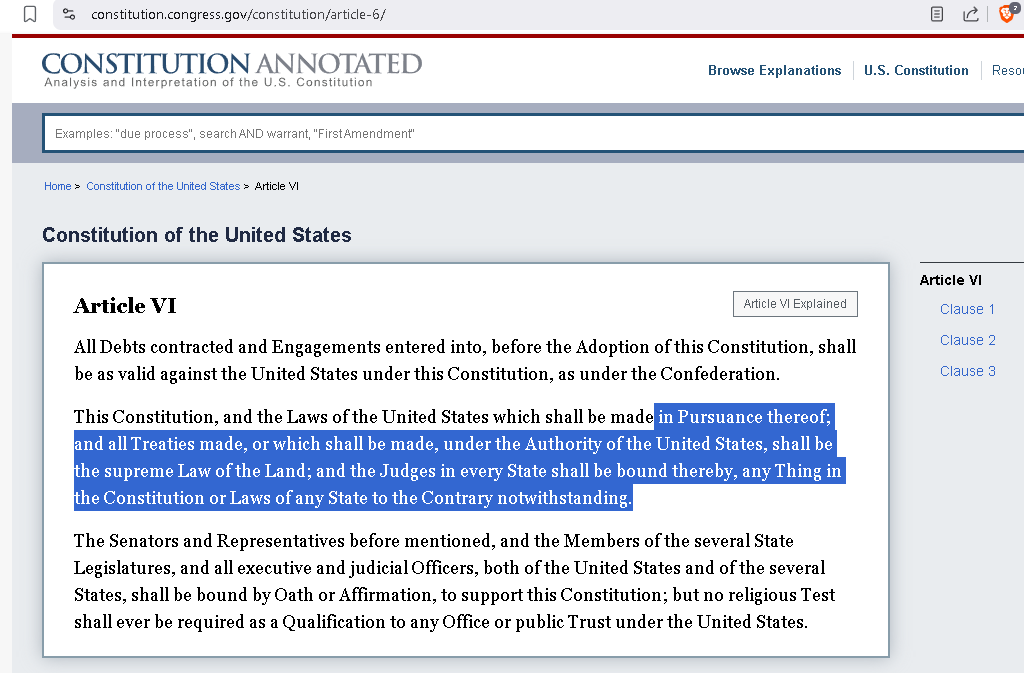
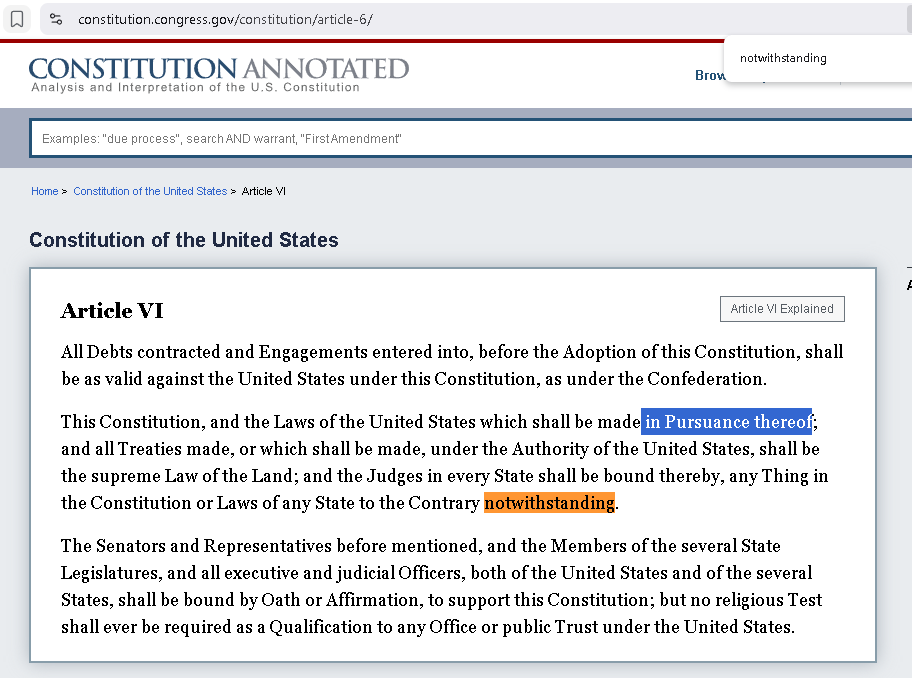
“the Laws of the United States which shall be made in Pursuance thereof;”
“all Treaties made, or which shall be made, under the Authority of the United States,”
“Treaties” are “made, under the Authority of the United States,”
“The United States”.. “shall be in Pursuance thereof;”
In Pursuance of what? (yes, Pursuance is intentionally capitalized)
“the supreme Law of the Land;”.
… “and the Judges in every State shall be bound thereby, any Thing in the Constitution or Laws of any State to the Contrary notwithstanding.”
Source
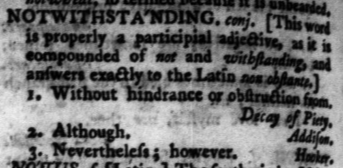
“NOTWITHSTANDING. conj. [This word is properly a participial adjective, as it is compounded of not and withstanding, and answers exactly to the Latin non obstante.]”
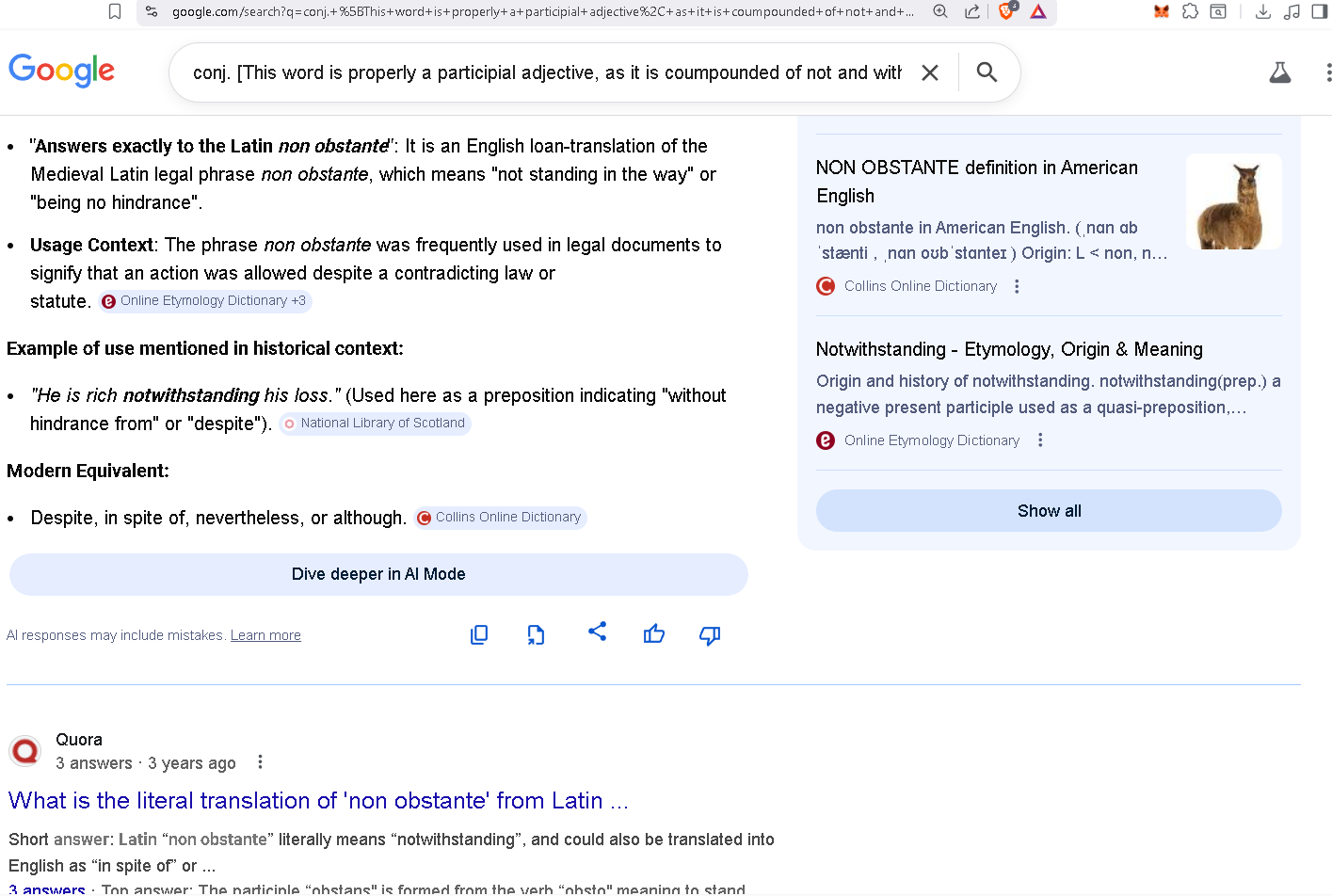
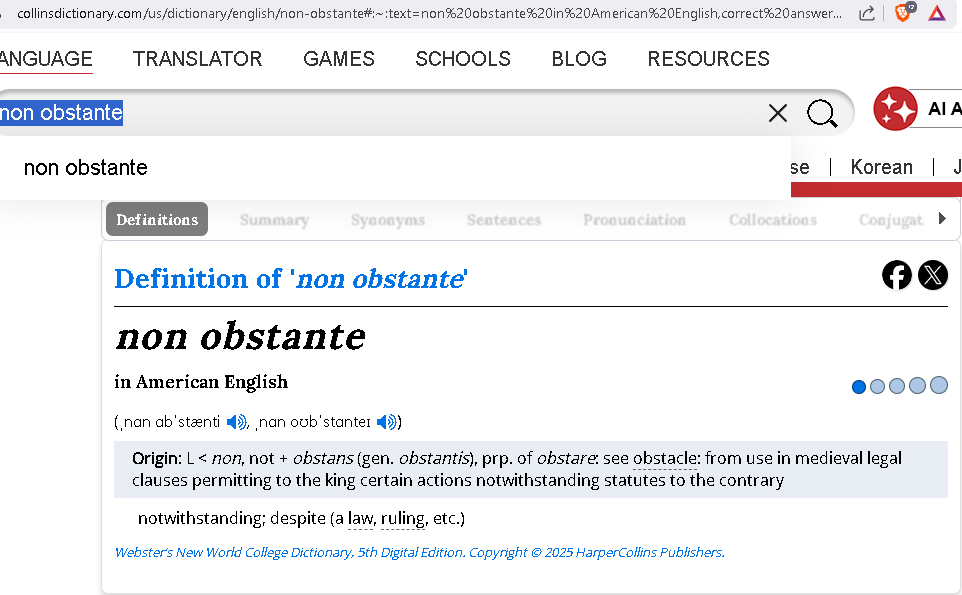
“Answers exactly to the Latin non obstante ” : It is an English loan-translation of the Medieval Latin legal phrase non obstante , which means “not standing in the way” or “being no hindrance”.
Source
Source
NEW! - 11 Am. Jur., 1d, Constitutional Law - 11 Am Jur 1d - Constitutional Law - Josef K Media - Charg (CHG) - zchg.org - Web Four, it's YOURS! Carl-Miller-Law-Study.pdf (1.3 MB) founding docs.zip (10.9 MB) constitutional-law-by-carl-miller.pdf...
Skip to a Solution (click here) Say, I have a question.. if the 16th Amendment were never properly ratified, or if portions of it were to be found repugnant, what would be the Constructively Operative portions of this Amendment? Let us explore...
It’s common knowledge by now that Wikipedia and Google are not ideal 1st sources per se, is it not? Notwithstanding, we can use this list for fodder.
This is a list of treaties to which the United States has been a party or which have had direct relevance to U.S. history.
Before the United States Declaration of Independence in 1776, the sovereign of the United Kingdom and the leaders of various North American colonies negotiated treaties that affected the territory of what would later become the United States.
Before the United States Declaration of Independence in 1776, the sovereign of the United Kingdom and the leaders of various North American colonies negotiated treaties that affected the territory of what would later become the United States.
These are treaties that the United States has made with other sovereign international states. This is mostly to distinguish them from the next category. Under the treaty clause of the United States Constitution , treaties come into effect upon final ratification by the President of the United States , provided that a two–thirds majority of the United States Senate concurs.[5]
1800 – Convention of 1800 (Treaty of Mortefontaine) – Ends the Quasi War between France and the U.S.
1803 – Louisiana Purchase Treaty – Acquire Louisiana Territory from the French First Republic .
1805 – Treaty with Tripoli [12] – Secured release of Americans being held in Tripoli , proclaimed peace and amity, and ended the First Barbary War .
1814 – Treaty of Ghent – Ends the War of 1812 between the U.S. and Great Britain, returning the two countries to the status quo ante bellum
1815 – Commercial treaty with Great Britain – Established free trade between the United States , England , and much of the British Empire (Ireland was among the areas excluded)[13] [14] [15]
1817 – Rush–Bagot Treaty – The United States and Great Britain agree to demilitarize the Great Lakes.
1818 – Treaty of 1818 – resolved boundary issues between U.S. and Great Britain and demilitarized the border.
1819 – Adams–Onís Treaty – purchase of Florida from the Spanish Empire and established the border with New Spain .
1824 – Russo-American Treaty – gave Russian claims on land off the Northwest Pacific coast of North America (north of the Oregon Country )
1824 – Anderson–Gual Treaty – between U.S. and Gran Colombia ; first bilateral treaty with another American country
1827 - Swedish–American Treaty (1827) - between the Kingdoms of Sweden and Norway and the United States
1828 – Treaty of Limits – between Mexico and the U.S.; confirms the boundary agreed to with Spain in the Adams–Onís Treaty .
1830 – Treaty with the Ottoman Port [16] [17] Also see Capitulations of the Ottoman Empire
1831 – Franco-American Treaty of 1831 – France agreed to pay reparations of 25 million francs for damage to American shipping during the Napoleonic Wars [18] (ratified in 1835 under Victor de Broglie ’s government – see July Monarchy )
1833 – Siamese–American Treaty of Amity and Commerce – a commercial treaty between the Kingdom of Siam and the United States, first treaty with an East Asian nation
1833 – Treaty with Muscat [19]
1835 – Treaty of New Echota – between U.S. government officials and representatives of a minority Cherokee political faction, the Treaty Party
1842 – Webster–Ashburton Treaty – ended the Aroostook War and settles boundary disputes between the U.S. and Canada
1844 - Tyler-Texas Treaty - Between the US and the Republic of Texas. Signed on April 12, 1844, was framed to induct Texas into the Union as a territory.
1844 – Treaty of Wanghia – between the U.S. and Qing Dynasty. Establishes five U.S. treaty ports in China with extraterritoriality . Imposes the first unequal treaty on the dynasty.
1846 – Mallarino–Bidlack Treaty with the Republic of New Granada (Colombia )
1846 – Oregon Treaty – brought an end to the Oregon boundary dispute by settling competing American and British claims to the Oregon Country
1847 – Treaty of Cahuenga – ends the Mexican–American War in Alta California
1848 – Treaty of Guadalupe Hidalgo – fully ends the Mexican–American War; sets the Rio Grande as the boundary between Mexico and Texas and cedes much of northern Mexico to the United States.
1849 – Treaty of Friendship, Commerce and Navigation – Treaty between the Hawaiian Kingdom and the United States
1850 – Clayton–Bulwer Treaty – U.S. and United Kingdom agree not to colonize Central America
1851 – Treaty of Fort Laramie – with the Cheyenne, Sioux, Arapaho, Crow, Assiniboine, Mandan, Hidatsa, and Arikara Nations
1851 – California Indian Reservations and Cessions – 18 lost treaties of California
1854 – Convention of Kanagawa – forcibly opens Japan to American trade
1855 – Canadian–American Reciprocity Treaty – with Canada on trade and tariffs
1855 – Treaty of Detroit – U. S. and Ottawa and Chippewa Nations of Indians which severed the link between the two Native American groups for further treaty negotiations and prepared the way for allotment of tribal land to individuals.
1858 – Treaty of Amity and Commerce , also known as Harris Treaty – forces the opening of treaty ports on Japan
1858 – Treaty of Tientsin – with China after the Second Opium War ; established peace, amity, and commerce
1862 – Treaty of Commerce and Navigation – with Ottoman Empire [17]
1864 – First Geneva Convention – established rules for the treatment of battlefield casualties and sick and wounded combatants
1867 – Alaska Purchase – U.S. buys Alaska from Russia
1868 – Burlingame Treaty – with China; established improved relations
1868 – Naturalization Convention – with North German Confederation ; first recognition by a European power of the legal right of its subjects to become American citizens
1868 – Naturalization Convention – with Belgium
1868 – Treaty of Bosque Redondo – with the Navajo ending the Navajo Wars
1868 – Treaty of Fort Laramie – with the Sioux and Arapaho ending Red Cloud’s War .
1869 – Naturalization Convention – with Sweden and Norway .
1870 – Naturalization Convention – with United Kingdom
1871 – Treaty of Washington – settles grievances between the U.S. and Canada including the Alabama Claims
1872 – Naturalization Convention – with Denmark
1883 – Paris Convention for the Protection of Industrial Property – intellectual property systems, including patents , of any contracting state become accessible to the nationals of other states party to the Convention
1886 – Berne Convention for the Protection of Literary and Artistic Works (ratified by U.S. in 1989)
1898 – Sixth Treaty of Paris – ends the Spanish–American War
1899 – Hague Conventions – one of the first formal statements of the laws of war
1900 – Treaty between Spain and the United States for Cession of Outlying Islands of the Philippines . Concluded November 7, 1900; ratification advised by Senate January 22, 1901 .. ratified by the President January 30, 1901; ratifications exchanged March 23, 1901; proclaimed March 23, 1901.
1901 – Hay–Pauncefote Treaty – nullified Clayton–Bulwer Treaty in exchange for free access to build a canal across Central America
1901 – Boxer Protocol , Peace Agreement between the Great Powers and China – one of the Unequal Treaties with China
1902 – Naturalization Convention – with Haiti
1903 – Hay–Herrán Treaty – the U.S. attempt to acquire a lease on Panama from Colombia (not ratified by Colombia)
1903 – Hay–Bunau-Varilla Treaty – establishes the Panama Canal Zone
1903 – Treaty of Relations – with the Republic of Cuba
1905 – Treaty of Portsmouth – ends Russo-Japanese War ; negotiated by President Theodore Roosevelt
1905 – Taft–Katsura Agreement – Japan and U.S. agree on spheres of influence in Asia
1906 – Second Geneva Convention – treatment of wounded, sick and shipwrecked members of armed forces at sea
1906 – Inter-American Convention Establishing the Status of Naturalized Citizens Who Again Take Up Residence in the Country of Their Origin
1907 – Gentlemen’s Agreement – limiting Japanese immigration to the U.S.
1907 – Naturalization Convention – with Peru
1908 – Naturalization Convention – with Portugal
1908 – Naturalization Convention – with El Salvador
1908 – Naturalization Convention – with Honduras
1908 – Naturalization Convention – with Nicaragua
1908 – Naturalization Convention – with Uruguay
1909 – Boundary Waters Treaty – regulates water quantity and water quality along the boundary between Canada and the United States.
1911 – Naturalization Convention – with Costa Rica
1911 – North Pacific Fur Seal Convention of 1911 – first international treaty for wildlife preservation
1912 – First International Opium Convention – first international drug control treaty
1916 – Treaty of the Danish West Indies – U.S. purchase of the Danish West Indies , renaming them the United States Virgin Islands
1917 – Lansing–Ishii Agreement – trade treaty between the U.S. and Japan
1918 – Migratory Bird Treaty – Environment treaty with the United Kingdom representing Canada, to protect birds which migrate between Canada and the U.S.
1919 – Treaty of Versailles – ended the state of war between Germany and the Allied Powers and established the League of Nations . Ultimately not ratified by the U.S. Senate .
1920 – Svalbard Treaty – recognizes Norwegian sovereignty over Svalbard and regulates its open access , economic activities, environmental protection, taxation and demilitarization
1921 – Peace Treaty – separate World War I peace agreement between United States and Austria[20]
1921 – Treaty of Berlin – separate World War I peace agreement between United States and Germany
1921 – Peace Treaty – separate World War I peace agreement between United States and Hungary[21]
1922 – Washington Naval Treaty – limits the naval armaments race , supplement to restrict submarine warfare and ban chemical warfare was rejected by France.
1925 – Anglo-American Convention – American acceptance of the provisions of the Mandate for Palestine and supervision of British performance as mandatory of the Mandate for Palestine.
1925 – Hay-Quesada Treaty – America accepts Cuban ownership of Isle of Pines .
1928 – Kellogg–Briand Pact – calls “for the renunciation of war as an instrument of national policy”
1929 – Geneva Convention on Prisoners of War – establishes rules for the treatment of prisoners of war
1929 – Warsaw Convention for the Unification of certain rules relating to international carriage by air – regulates civilian air travel
1930 – London Naval Treaty – regulates submarine warfare and shipbuilding
1930 – Convention Between the United States and Great Britain – Definitely delimits the boundary between North Borneo (then a British protectorate ) and the Philippine archipelago (then a U.S. Territory )
1934 – Treaty of Relations – agreements between United States and Cuba[22] s:United States – Cuban Agreements and Treaty of 1934
1937 – Treaty Defining Liability for Military Service, etc. – with Lithuania
1943 – Treaty between the United States and China for the Relinquishment of Extraterritorial Rights in China – relinquishes extraterritorial rights granted to the United States in China under the Treaty of Wanghia .
1944 – Bretton Woods Agreement – establishes the rules for commercial and financial relations among the major industrial states
1945 – UN Charter – establishes the United Nations
1946 – Bermuda Agreement – bilateral treaty on Civil Aviation between U.S. and United Kingdom
1946 – Treaty of Manila – United States recognizes independence of the Republic of the Philippines
1947 – General Agreement on Tariffs and Trade (GATT) – establishes rules for international trade
1947 – Paris Peace Treaties – establishes peace in Europe after World War II .
1947 – Inter-American Treaty of Reciprocal Assistance (Rio Treaty) – Western Hemisphere mutual defense
1947 – Convention on International Civil Aviation (Chicago Convention) – establishes International Civil Aviation Organization (ICAO)
1949 – North Atlantic Treaty (Treaty of Washington) – establishes NATO mutual defense organization
1949 – Fourth Geneva Convention – establishes rules for the protection of civilians during times of war
1949 – Treaty of Friendship, Commerce and Navigation – establishes amiable relations between the U.S. and the Republic of China .
1951 – Convention on the Prevention and Punishment of the Crime of Genocide – (with U.S. qualifications)
1951 – Treaty of San Francisco – a peace treaty between the Allied Powers and Japan ; ends the Pacific conflict of World War II
1951 – Mutual Defense Treaty – alliance between the Republic of the Philippines and the United States of America
1951 – Treaty of Security between the United States and Japan (updated 1960)
1952 – ANZUS Treaty – mutual defense alliance between Australia , New Zealand , and the United States
1953 – Mutual Defense Treaty – Created an alliance with South Korea , and established the basis of South Korean adherence with U.S. government consultations on North Korean policy
1954 – U.S. and Japan Mutual Defense Assistance Agreement
1954 – Southeast Asia Collective Defense Treaty – creates SEATO mutual defense organization
1954 – Sino-American Mutual Defense Treaty – alliance between the United States and Taiwan
1955 – Central Treaty Organization (CENTO), formerly known as Middle East Treaty Organization (METO), also known as the Baghdad Pact – creates CENTO mutual defense organization
1955 – The Open Skies Treaty – allow access to other nations’ military activities by means of aerial surveillance flights
1955 – Treaty of Amity, Economic Relations and Consular Rights – provided friendly diplomatic relations between the United States and Iran .
1956 – Dutch–American Friendship Treaty
1957 – International Atomic Energy Treaty (US PL 85–177)
1958 – Mutual Defense Agreement – commenced the “Special Relationship ” with the United Kingdom
1960 – Treaty of Mutual Cooperation and Security – mutual defense treaty with Japan
1961 – Antarctic Treaty – governs international relations in Antarctica
1961 – Columbia River Treaty (ratified in 1964) – with Canada to manage water in the Columbia River valley
1961 – Vienna Convention on Diplomatic Relations – specifies diplomatic immunity
1961 – Alliance for Progress – economic cooperation treaty with Latin America
1961 – Single Convention on Narcotic Drugs
1962 – Nassau Agreement – defense treaty with United Kingdom
1962 – Joint Declaration on Commercial Relations – with the European Economic Community , signed March 7, 1962
1963 – Vienna Convention on Consular Relations – treaty on consular protocol
1963 – Vienna Convention on Civil Liability for Nuclear Damage – provides liability in the case of a nuclear accident
1963 – Partial Nuclear Test Ban Treaty – Prohibited nuclear weapons testing except for underground tests .
1966 – Treaty of Amity and Economic Relations – commercial treaty with the Kingdom of Thailand
1966 – International Convention on the Elimination of All Forms of Racial Discrimination – treaty prohibiting racial discrimination .
1967 – Outer Space Treaty – Basis for space law . Prohibits use of weapons of mass destruction , including nuclear weapons, in space
1968 – Nuclear Non-Proliferation Treaty – Prohibits signatories from acquiring nuclear weapons and commits nuclear-armed states to nuclear disarmament .
1968 – Protocol Relating to the Status of Refugees
1969 – Vienna Convention on the Law of Treaties – provides rules on making international treaties. The United States is not a party to this treaty.
1970 – Patent Cooperation Treaty (PCT) – Provides unified procedure on patent applications
1970 – Boundary Treaty – settles U.S. – Mexico border on Rio Grande
1971 – Geneva Phonograms Convention – provides copyright protections for audio recordings
1971 – Convention on Psychotropic Substances – restricts the import and export of psychotropic drugs .
1972 – Anti-Ballistic Missile Treaty (ABM Treaty) (U.S. withdrew in 2002) – limited anti-ballistic missiles
1972 – SALT I (Strategic Arms Limitation Treaty) – provided limitations on new intercontinental ballistic missile launchers and submarine-launched ballistic missiles
1972 – Biological Weapons Convention – prohibited production of biological weapons
1972 – Convention on the Prevention of Marine Pollution by Dumping of Wastes and Other Matter (London Convention) (implemented by U.S., but not signed) – regulates waste disposal from vessels at sea
1972 – Great Lakes Water Quality Agreement – regulates water quality along the U.S.-Canada border
1973 – Paris Peace Accords – with North Vietnam ending the Vietnam War
1974 – Threshold Test Ban Treaty – limited nuclear testing to 150 kilotons per year
1977 – Torrijos-Carter Treaties – transfer of Panama Canal to Panama
1978 – Camp David Accords – peace treaty between Israel and Egypt ; negotiated and signed in U.S.
1978 – Great Lakes Water Quality Agreement – regulates water quality along the U.S.-Canada border
1978 – Treaty on maritime boundaries between the United Mexican States and the United States of America[23]
1979 – SALT II (not ratified by U.S.) – sought to limit production of strategic nuclear weapons
1979 – Treaty of Tarawa – recognizes sovereignty of Kiribati over disputed islands
1980 – Maritime Boundary Treaty – settles disputed claims and establishes the maritime boundary between American Samoa and the Cook Islands
1980 – Hague Convention on the Civil Aspects of International Child Abduction
1980 – Treaty of Tokehega – settles disputed claims and establishes the maritime boundary between American Samoa and Tokelau
1985 – Plaza Accord – G-5 agreed to devalue the U.S. dollar in relation to the Japanese yen and German Deutsche Mark by intervening in currency markets
1986 – Vienna Convention on the Law of Treaties between States and International Organizations or Between International Organizations
1986 – United Nations Convention on Contracts for the International Sale of Goods – regulates contracts on international trade
1988 – Intermediate-Range Nuclear Forces Treaty (INF) – dismantled all short-range and intermediate-range ballistic missiles of the United States and the Soviet Union.
1988 – United Nations Convention Against Illicit Traffic in Narcotic Drugs and Psychotropic Substances – provides legal mechanisms on enforcement of previous narcotics treaties
1988 – United Nations Convention Against Torture – prohibited use of torture and cruel and unusual punishment
1989 – Montreal Protocol on Substances That Deplete the Ozone Layer
1990 – Treaty on the Final Settlement with Respect to Germany – final World War II peace with Germany and Allies
1991 – Treaty on Conventional Armed Forces in Europe – Signed by all 16 NATO members and Warsaw Pact nations; ratified by all 16 NATO states, the eight successor states to the USSR that have territory in Europe, and the six former Warsaw Pact nations
1991 – START I (Strategic Arms Reduction Treaty) – limited amounts of nuclear warheads, ballistic missiles , and strategic bombers between the United States and the Soviet Union
1992 – International Covenant on Civil and Political Rights (ratified with qualifications by U.S. Senate) – commits signatories to respect civil and political rights
1992 – United Nations Framework Convention on Climate Change – limited carbon emissions
1993 – Oslo Accords – between the Palestine Liberation Organization and Israel ; negotiated with U.S. involvement
1993 – Chemical Weapons Convention – prohibits chemical weapons
1993 – START II (ratified by U.S. and Russia) – prohibited intercontinental ballistic missiles with multiple independently targetable reentry vehicles
1994 – North American Free Trade Agreement (NAFTA) – removed tariffs and trade barriers between the United States, Mexico , and Canada
1994 – Convention on the Limitation Period in the International Sale of Goods – regulated contracts on sales of goods
1994 – Kremlin accords – US and USSR missile and nuclear weapons control; ended preprogrammed targeting of strategic nuclear missiles
1994 – United Nations Convention on the Law of the Sea (LOS) (not ratified by U.S.)
1995 – Dayton Agreement – ended the Bosnian War and determines the future of Bosnia and Herzegovina ; negotiated and signed in U.S.
1995 – General Agreement on Trade in Services (GATS) – extended multilateral trade to the service sector
1996 – WIPO Copyright Treaty – protects computer programs and databases
1996 – WIPO Performances and Phonograms Treaty
1996 – Comprehensive Nuclear-Test-Ban Treaty (signed but not ratified by U.S.) – completely prohibits nuclear weapon testing
1997 – Worldwide Chemical Weapons Convention
1998 – Rome Statute of the International Criminal Court (unsigned by the U.S.) – established the International Criminal Court
1999 – Convention for the Unification of Certain Rules for International Carriage by Air – modified the 1929 Warsaw Convention